Godot vs Unity vs Unreal for AI-assisted development
Licence, cost, file formats, command line and web export for the three big engines, checked on 2026-10-27. Text files and a headless command line favour Godot.
Part 2 gave a judgment. This part gives the facts behind it. Every fact here was checked against an official page on 2026-10-27. Prices are in US dollars and change often, so check the vendor’s page before you sign anything.
The table
| Godot | Unity | Unreal Engine | |
|---|---|---|---|
| Current version | 4.7.2 (Aug 2026) | 6.6, with 6.3 as the long-term support version | 5.8 (June 2026) |
| Licence | MIT, open source | Proprietary | Proprietary, source code available |
| Cost to start | Free | Free up to $200,000 revenue and funding | Free |
| Paid tier | None | Pro: $2,310 per seat per year | Only for non-game use above $1M |
| Royalty | None | None | 5% of lifetime revenue above $1M per game |
| Scripting | GDScript, C#, C++ | C# | C++, Blueprints (visual) |
| Scene files | Text (.tscn) | Text (YAML) or binary | Binary (.uasset, .umap) |
| Command line | --headless, --export-release | -batchmode, -executeMethod | RunUAT, -run=pythonscript |
| Consoles | Through third-party ports | Yes, with extra setup | Yes |
| Web export | WebGL 2 only, no C# | WebGL 2, WebGPU with limited support | No official export |
A royalty is a share of your game’s sales that you pay to the engine maker. “Headless” means the engine runs with no window, so a script or an agent can drive it.
Move the slider to see what each engine would cost you at a given revenue. It uses only the prices in the table.
Godot stays free. Unity asks for Pro above $200,000, per seat each year. Unreal takes 5% only of the money above $1 million.
Godot: everything is a file the agent can read
Godot uses the MIT licence. You pay nothing and owe no royalty. You only need to show Godot’s copyright notice in your credits or documentation.
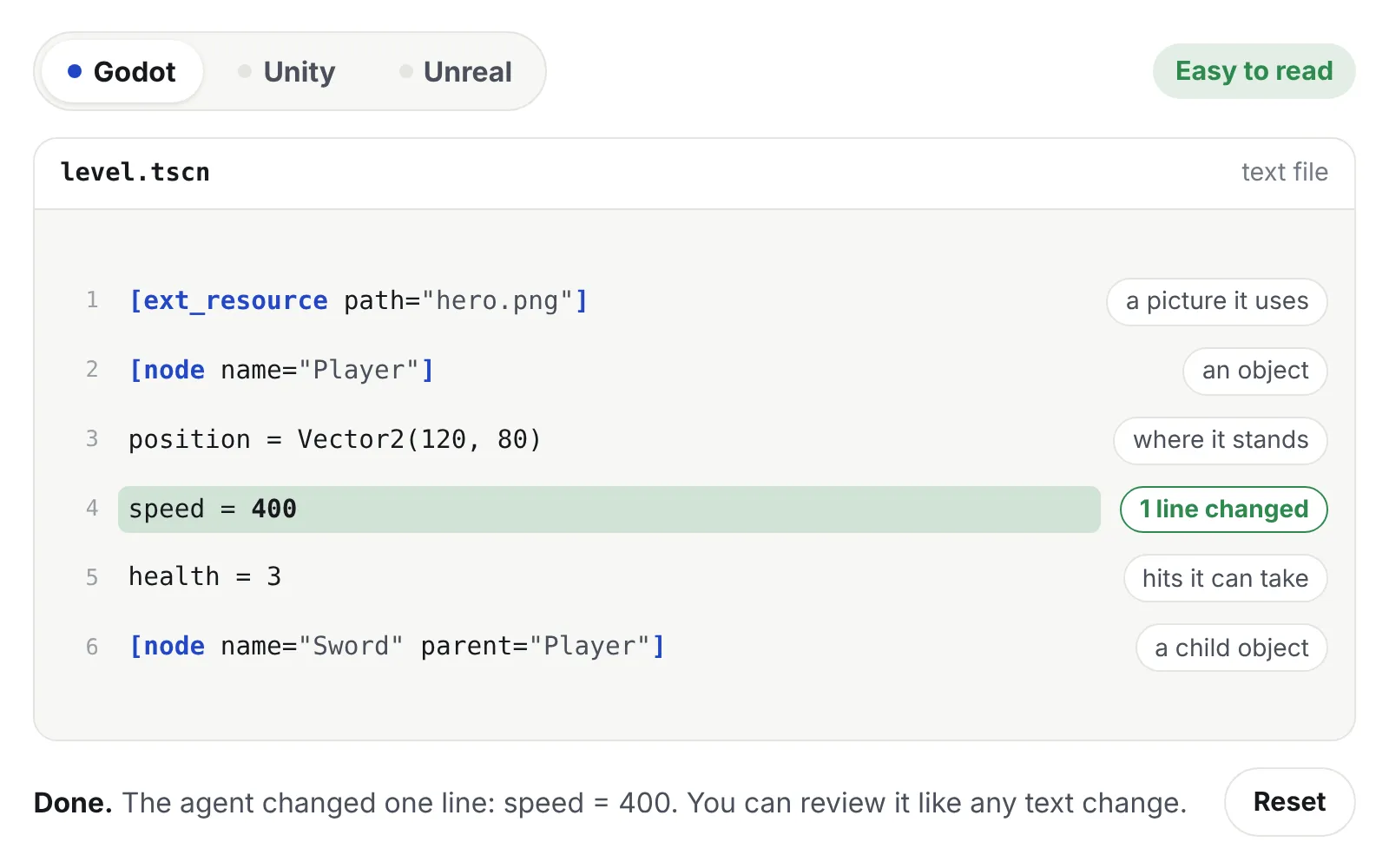
For an agent, two facts matter most. First, scenes are .tscn text files. The agent can open a scene, read its list of objects and change a property in one line. You can review that change like any other text change. Second, --headless runs the engine with no window, and --export-release builds the game from a script. So an agent can edit, build and run the game in a loop without you.
The weak spot is the web. Godot 4 web builds use WebGL 2 and the simpler “Compatibility” renderer only. Projects written in C# cannot export to the web at all. For a browser game, use GDScript. Consoles are not part of the open-source engine. You need an approved developer account and a port from a third party such as W4 Games.
Unity: lots of example code, a slower loop
Unity cancelled its Runtime Fee, a charge per install, on 12 September 2024. Unity now has no royalty. Personal is free up to $200,000 in revenue and funding. Above that you need Pro, which rose 5% in January 2026. With Unity 6, the “Made with Unity” splash screen is optional on Personal.
For an agent, Unity sits in the middle. Models write C# well, and there is a lot of public Unity code. Scenes can be saved as YAML text, so the agent can read them. But the YAML is long and full of number IDs. It is safer to let the agent change scenes through C# editor scripts. Batch mode runs those scripts from the command line. Unity also has an official MCP server, but it is part of an open beta and needs a Unity Cloud connection.
Web export works. WebGL 2 is the default. WebGPU is available, but browser and device support is limited.
Unreal: powerful, but closed to text tools
Unreal is free until a game earns $1 million in total. After that, Epic takes 5% of the revenue above $1 million, per game. Sales on the Epic Games Store do not count.
For an agent, Unreal is the hardest of the three. Levels, Blueprints and most assets are binary .uasset files. Epic’s own docs say they cannot be merged in a text tool. The agent can write C++ and run Python inside the editor, also with no window. RunUAT builds the game from the command line. But the loop is slow, and much of the game lives in files the agent cannot read. Unreal 5.8 adds an experimental MCP plugin that lets an agent work with Blueprints, assets and levels through the editor. This may change the picture, but it has not been tested here.
Unreal has no official web export.
What this means for an agent
An agent works through text and commands. Switch between the tabs below to see a scene file the way an agent sees it, then ask it to make the player faster.
Godot: one readable line per setting. Unity: text tied together by long ID numbers. Unreal: binary bytes a text tool cannot read. The lines are simplified examples.
Godot gives an agent text and commands for the whole project. Unity gives it both for code, and editor scripts for the rest. Unreal gives it code and some scripting, but not the levels and Blueprints.
Next: can you skip the engine and make a game in the browser?