A full chapter in four sections, and how hard it is
Four prompts grew twelve rooms into a 24-room chapter with crumbling blocks and refill orbs, one section per session. A fifth measured every room and reshaped the difficulty into waves. Play all 24.
This is the real result. Click it and play. Open full screen
What we asked“Players get better as they go. Check how hard each room is for a new, an average and a skilled player, then adjust the rooms so the game gets harder in waves as the player improves. Don't change how the character moves.”
What happened
- Used the platformer-levels skill
- Ran the skill's difficulty script on all 24 rooms: 200 attempts for each of three player types, with two random seeds
- Found three problems in the shape of the whole game
- Changed five rooms by a few pixels each and re-measured after every change
- Re-ran every route, the full playthrough and the wrong-way routes
- Worked through all 15 pairs of the six elements and wrote levels/COMBINATIONS.md
- Chose two combinations out of 15 and built five optional rooms from them
- Measured each room 200 times with two seeds and changed rooms until they landed in their bands
- Checked that every route and wrong-way route still behaves, and that removing an orb, pad or slab makes its room impossible
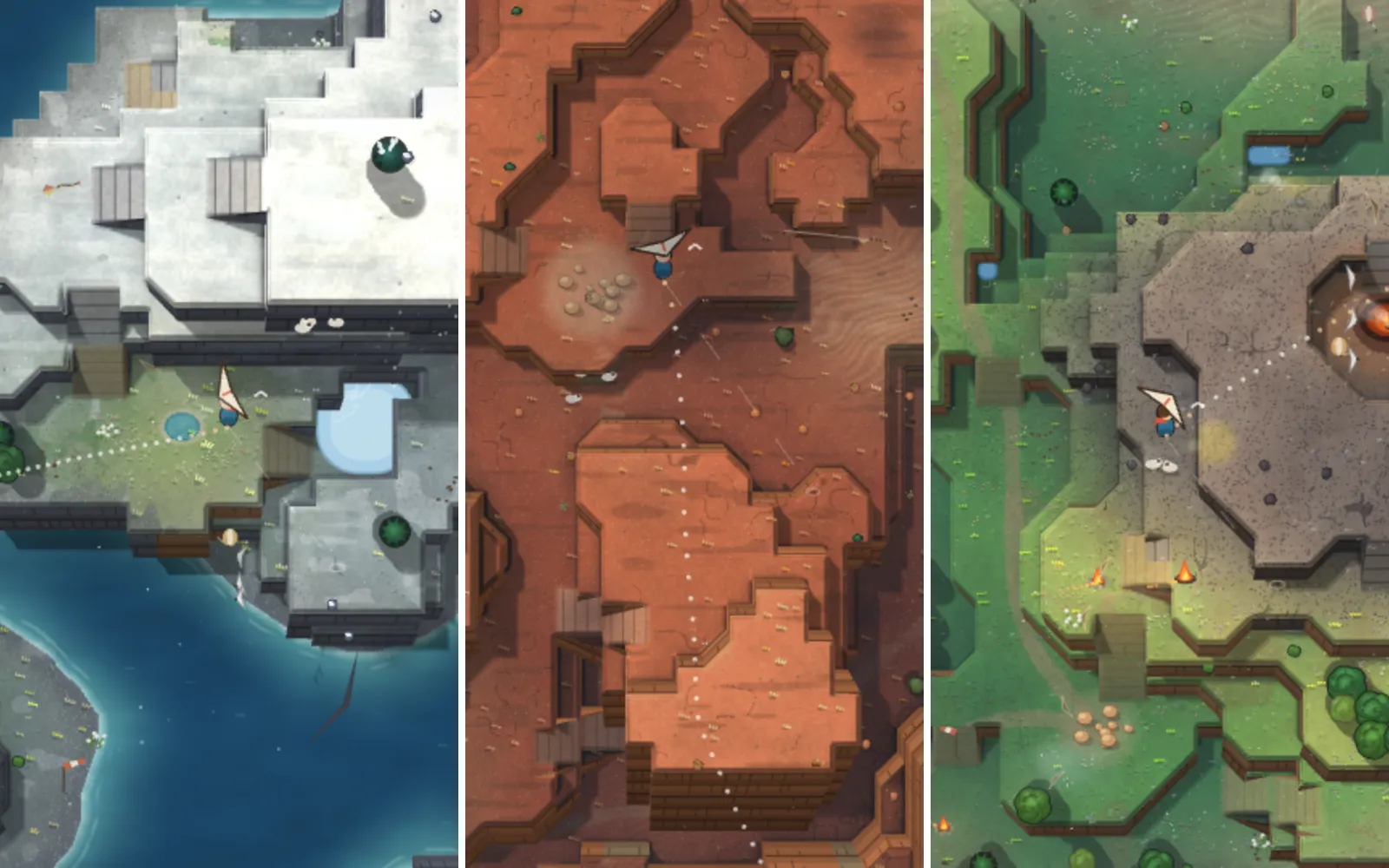
After part 2 the game has twelve rooms. A chapter is a different job: more rooms means more sessions, and the risk is a game that is just a long row of rooms. We built the chapter one section at a time, each in its own Claude Code session and its own file, so each session had one small thing to do.
Step 5: new mechanics, then one section at a time
First session: the two new things, and the plumbing. No rooms yet.
I want to turn this into a real chapter that takes a while to finish. First add two new things: crumbling blocks that shake and fall a moment after you land on them, then come back after a while, and refill orbs that give you your double jump back in mid-air and reappear after a few seconds. Keep each section's rooms in its own file so sections can be built separately, keep the rooms we already have as the first two sections, and add a death counter, a timer and an end screen that shows them. Test both new things. Don't build new rooms yet.It took 20 minutes and $2.15. A crumbling block shakes for half a second after you stand on it, drops, and comes back 2.5 seconds later. A refill orb gives back a double jump you have already used in mid-air, then relights after 2.5 seconds. A jump, double jump and third jump through an orb reaches about 290 px; the same presses without the orb reach about 195 px. The rooms moved into levels/section-1.js and section-2.js, and 48 new checks run at 30, 60 and 144 frames per second.
Then one prompt per section. These two were the same shape:
Build the next section in its own file: about six rooms about the crumbling blocks. Start with a safe first meeting, build up to a test room, and mix them with the jumps and springs the player already knows. Measure the new rooms with the skill's script and adjust them until they hit their targets.Build the next section in its own file: about six rooms about the refill orbs. Start with a safe first meeting, build up, and end the section with a test room that puts the crumbling blocks, springs and orbs together. Measure the new rooms with the skill's script and adjust them until they hit their targets.Section 3, Sandstone Quarry, took 20 minutes and $3.53. Section 4, Lantern Ridge, took 39 minutes and $4.37. Both finished with every room inside its target band. The pass rate is for a simulated player who has played up to that room:
| Room | Beat | Reached | Target |
|---|---|---|---|
| 14 Soft steps | introduce | 100% | 90% or more |
| 15 Thorn causeway | develop | 77% | 50 to 85% |
| 16 Trapdoor | twist | 59% | 50 to 85% |
| 18 Quarry delivery | test | 53% | 30 to 60% |
| 21 Lantern bridge | develop | 80% | 50 to 85% |
| 22 Lantern chimney | twist | 68% | 50 to 85% |
| 24 Lantern delivery | test | 54% | 30 to 60% |
Each section starts at a safe rest spot, introduces the new thing in a room where nothing can hurt you, and ends in a test room. In Lantern Ridge, taking the orbs out of a temporary copy made every route from room 20 on fail, so each room really needs its orb.
Step 6: measure the whole game, not only the rooms
Every room was inside its own target, yet the game as a whole didn’t climb: the Lantern Ridge rooms were easier than the Quarry’s. One prompt fixed that.
Players get better as they go. Check how hard each room is for a new, an average and a skilled player, then adjust the rooms so the game gets harder in waves as the player improves. Don't change how the character moves.It took 41 minutes and $1.69, and it changed five rooms by a few pixels each. The jumps are close to the hero’s reach, so a few pixels move the pass rate a lot: in Second wind, moving the bramble bed 12 px dropped the pass rate from 83% to 58%, and 6 px gave 74%.
| Room | Change | Before, then after |
|---|---|---|
| 5 Long leap | pit 270, then 276 px | 91% to 78% |
| 6 Delivery | first pit 210, then 235 px | 80% to 67% |
| 10 Second wind | bramble bed 6 px right | 83% to 74% |
| 21 Lantern bridge | one more thorn | 80% to 67% |
| 22 Lantern chimney | cliff 3 px taller | 72% to 57% |
Here is every room, before and after. Switch between a new, an average and a skilled player, and tap a room for its numbers.
Our chart, from the sessions' own measurement tables. The "before" numbers come from a quicker 50-attempt run, so a few points of difference in one room are noise. The big moves are not.
Each world starts at 100% with a rest spot and a new element, climbs to its test room, and the peak gets harder from world to world: 67%, 56%, 53% and 53% for a player who has reached the room. A player who isn’t improving finds the test rooms much harder: 91%, 78%, 67% and then 61% for an average player.
Play it
The whole chapter is here, 24 rooms, before and after the difficulty pass. There is no way to skip ahead, and each room restarts on a death.
Before: the chapter as the four section sessions left it. Starts at Second wind; the rest of the game is ahead of you if you want it.
After: the same rooms, five of them a few pixels different. In Second wind the bramble bed is 6 px further right, which takes the pass rate from 83% to 74%. Try it in both. Starts at Second wind; the rest of the game is ahead of you if you want it.
Step 7: what happens when the elements meet
Every element so far was taught alone, in its own room. A game gets its depth from the combinations, and that is a separate question: which pairs make a situation neither makes alone? We ran this as a side branch from the finished 24-room game, so the later parts of this series do not include it. The prompt asks for the thinking first and the rooms second.
Claude went through all 15 pairs of the six elements: ordinary jump (J), double jump (D), spring pad (S), crumbling block (C), refill orb (O) and thorns (T). Here are the pairs it found worth a sentence of argument. The full table is in the file it wrote.
| Pair | What only the pair makes | Room? |
|---|---|---|
| O × T | Under a thorn roof, the orb means further, not higher | Yes, best |
| D × S | The pad gives the double jump back, so spend it to reach the pad | Yes, second |
| C × O | A slab drops you with the double jump still unspent | Runner-up |
| J × T | Overhead thorns make jump height matter | Only inside O × T |
| J × O | Nothing: the jump is unspent, so the orb does nothing | No |
| S × C | Trapdoor: standing on a slab drops you onto a pad | Already in the game |
The other nine were already in the game or only added difficulty. Claude’s reason for rejecting the pad launching you into a slab from below is the one a human designer would give: it reads like a bug.
It built Briar Hollow, five optional rooms behind a side door at the start of Moss terrace, with the teaching order the skill asks for.
| Room | Beat | Combination | Pass rate (player who reached it) |
|---|---|---|---|
| Low roof | introduce | orb × stone roof | 94% |
| Briar tunnel | develop | orb × thorn roof | 63% |
| Free refill | introduce | spring × double jump | 93% |
| Spring ladder | develop | spring × double jump over thorns | 61% |
| Briar delivery | test | both | 41% |
Our table, from the session's measurement output: 200 runs with each of two seeds. Introduce rooms must be at least 90%, develop rooms 50 to 85%, the test room 30 to 60%.
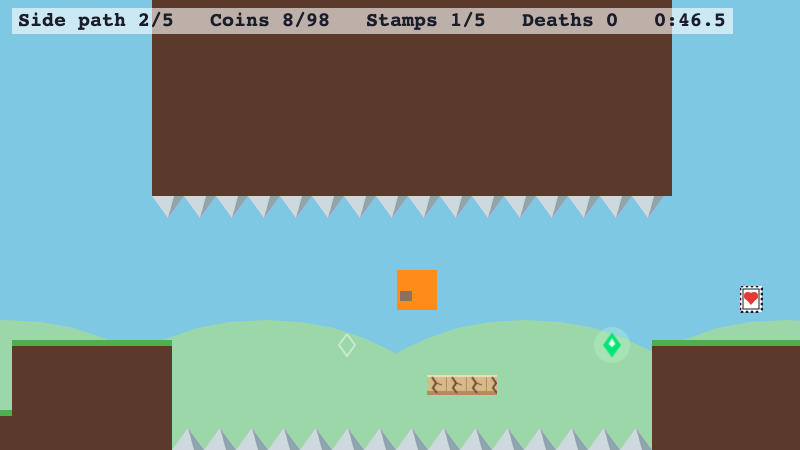
The tunnel is the one that matters. Every room before it rewards holding the jump button. Here a held jump hits the thorns, and the way across is a chain of short taps with the orbs as low stepping stones. The room teaches “go lower to go further” by first showing the same roof made of stone, where holding only bumps your head.
The session had to fight for the numbers. Low roof started at 86%, below the 90% an introduction needs. Moving the orbs earlier made it worse. What worked was making the far bank lower, then sinking the ditch floor so the bank could not be climbed. Free refill started at 46%, and doubling the pads fixed it. It also found a rule for future rooms that is not in the skill yet: over a thorn bed on solid ground, the jump buffer turns a slightly late tap into a ground jump, which ate the taps. Sinking the thorn bed solved it.
The chapter with the side path. Walk left from the start of Moss terrace (room 23) into the dark doorway with the red heart. Each of the five rooms holds a stamp that counts if you leave the room carrying it; nothing needs stamps. Starts at Low roof; the rest of the game is ahead of you if you want it.
Two further checks passed: removing an orb, pad or slab from a room made it impossible, so each element is needed, and the 20 wrong-way routes still reach no exit.
What to take from this
- The last two test rooms both sit at 53%. Claude tried to make Lantern delivery harder and couldn’t: moving the last ledge further made it impossible because that jump is already at the hero’s limit, and three other changes did nothing. It left it and said so.
- Ask for combinations in their own session. The work is the thinking first: pairs, what each makes, which to skip. Thirteen of fifteen were not worth a room.
- One session per section kept every prompt small and every file separate. The total for the five prompts here is about $12 and about two hours.
- Ask for the shape of the whole game. Each room can pass its own check while the game is flat. “Harder in waves” is a request about the game, not a room.
- The numbers are simulated. They measure timing, not whether a room is confusing. Watch one real person play.
Get the skill. Next: effects and sound.
The skill that made it work
It plans a game in areas, gives each section one new element, and ships a script that plays every room 200 times with simulated new, average and skilled players.
- Build one section per file and one session per section, so nothing has to be merged.
- Measure every new room with the script and adjust it until it lands inside its target pass rate.
- Check the whole game, not only each room: the difficulty should rise in waves, with a calm room before each test room.
Save it as .claude/skills/platformer-levels/SKILL.md in your project.
Was this useful?
Thanks, we read every message.
Part 3 of Make a complete platformer with AI