Which engine should you pick if an AI writes the code?
An agent reads files and runs commands. It cannot click an editor well. Five things decide which engine it can work in, and where each engine stands.
You describe the game. An AI coding agent, such as Claude Code, Codex or Cursor, writes most of the code. That changes which engine is “best”.
A person picks an engine for its editor. An agent cannot click an editor well. It reads files, runs commands and reads the output. So ask this: which engine lets the agent see, change and check the whole game through text?
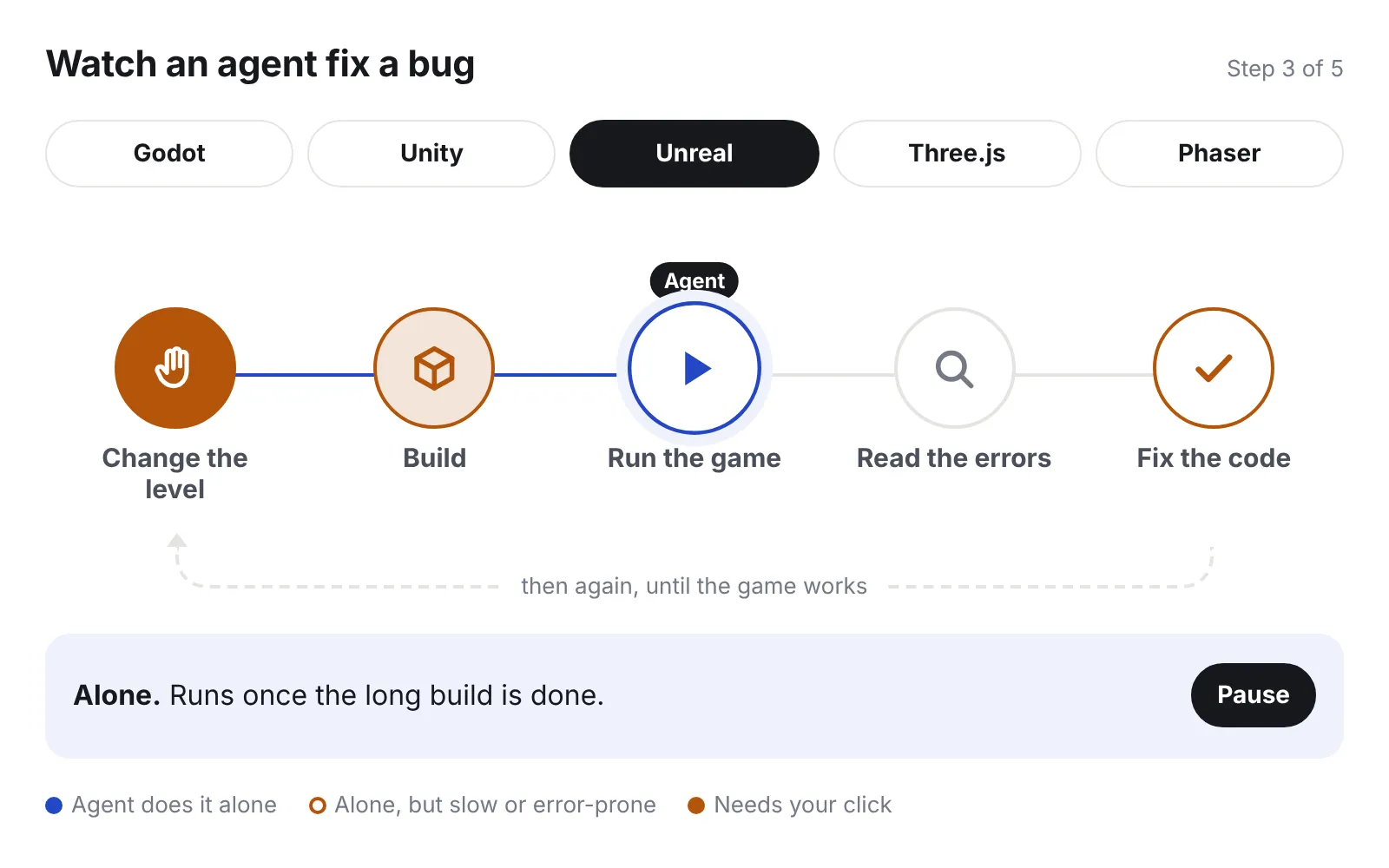
Try it below. Pick an engine and watch an agent fix one bug. Blue steps it does alone. Orange outlines are steps it can do, but slowly or with mistakes. A hand means it stops and waits for you to click in the editor.
One bug, five steps. Each step's note comes from the five things below.
Five things that matter
1. Scene files are text. The agent edits files. If a scene or level is a text file, the agent can read it and change one line. You can see that change in a diff, which is a view of exactly what changed. Godot saves scenes as text (.tscn files). Unity can save scenes as text, but they are full of number IDs that are hard to edit by hand. Unreal saves levels and Blueprints as binary .uasset files. Binary means the agent cannot read or merge them. Web libraries like Three.js and Phaser have no scene file at all, because the scene is code.
2. Build, run and test without a window. The agent needs to run the game, see the errors and try again, many times, without you pressing Play. Godot has a real headless mode (it runs with no window) and exports from the command line. Unity has batch mode. Unreal has a command-line build tool, but its builds are long and heavy. For web games, npm run build and a headless browser cover everything.
3. How well the models know the engine. The agent writes what it has seen most. More documentation, more years of examples and an API that changes little all help. Three.js and Unity have a huge amount of public code. Godot 4 renamed many classes from Godot 3, so models sometimes mix the two versions.
4. A language models write well. TypeScript and C# are among the languages models write best. A compiler checks them and catches mistakes before you run the game. GDScript, Godot’s own language, is simple and close to Python, and models handle it well enough. Unreal C++ uses many special engine macros and compiles slowly. Unreal’s visual language, Blueprints, is not text at all.
5. Tools that let the agent drive the editor. An MCP server lets the agent use the editor as a set of tools: open a scene, add an object, read the console. Unreal 5.8 has an experimental one. Unity has an official one in an open beta. Godot has community-made ones. Web libraries do not need one. Part 5 explains this in detail.
Licence terms matter too. Godot, Three.js and Phaser are free with no royalties. Unity and Unreal are free up to a revenue limit. Part 3 has the exact numbers.
The ratings
These ratings (out of 5) are judgment from use and reading the documentation. They are not benchmarks. Tap a column to sort the engines by it. The exact numbers are in the table under it.
"All three" adds the columns up, out of 15.
| Run without a mouse | Models write it well | Agent tools and licence | |
|---|---|---|---|
| Godot | 5 | 3 | 4 |
| Unity | 3 | 4 | 3 |
| Unreal Engine | 2 | 2 | 3 |
| Three.js | 5 | 4 | 5 |
| Phaser | 5 | 4 | 5 |
Phaser 4 is the current version, but most code online is Phaser 3. Models may write the old style.
Two more options
Bevy is a Rust engine where everything is code, which agents like. It is still in version 0.x and breaks its API about every three months, so the agent’s knowledge goes stale fast. Defold is a small, free engine with good 2D and web export. There is much less public code for models to learn from.
The recommendation
- Most beginners: Godot 4. Scenes are text, it runs headless, GDScript is simple, and the MIT licence never asks for money. Write “Godot 4” in every prompt, and keep the docs for your exact version open.
- Web-first game, or you know the web: Three.js with TypeScript. The whole game is one program, and the compiler catches the agent’s mistakes. You build your own scene tools, menus and saving. For a 2D web game, Phaser is the same idea with more built in.
- Consoles from day one, or you need the Asset Store: Unity.
- Unreal: only if you already know it. Its power is real, but binary files and long C++ builds make it the hardest place for an agent to work alone.
Model quality changes fast, so check again before you commit to one.
Next: the hard facts about Godot, Unity and Unreal side by side.