Why dying feels so punishing: game checkpoint design, instant retry and three more tricks
Five ways to make failure cost seconds instead of minutes: checkpoints before hard spots, mid-points, instant retry, skippable boss intros and something kept on death.
What we asked“Make a web page that demonstrates the checkpoint and retry tricks that make dying cheap but still meaningful one at a time, so anyone can see and feel each one within a few seconds. For each one, show the same short moment side by side: without it on the left, with it on the right, playing in a loop, with a caption that says what just happened and a replay button. Where it helps, let me play the moment myself. It will sit inside a blog post about 720 pixels wide, so it has to look good at that width and on a phone. Also make each one viewable alone with ?trick=<id>&solo, using these ids: checkpoint-before, split-long, instant-retry, skip-intro, keep-on-death. Show a small timer on each side counting the seconds and replay lost per death, so the difference is a number as well as a feeling. Use the internet freely for better results: free CC0 art, fonts or small libraries (for example Kenney's CC0 assets) are welcome; download anything you use into this folder so the page works without outside links, and list each item with its licence and source in CREDITS.md.”
What happened
- Loaded the checkpoints-and-retry skill
- Downloaded Kenney's CC0 Pixel Platformer art and Kenney Fonts
- Wrote the game simulation without any drawing code first, so the scripted runs could be tested on their own
- Kept Kenney Future only for labels and in-game banners, because its "K" reads like an "H" ("CHECHPOINT")
- Tightened the phone layout so both sides of a demo fit on one phone screen
- Played sides by hand: YOU DIED waits for a key on the left, R restarts at once on the right
Dying is part of a hard game. What makes it feel punishing is everything around the death: the death animation, the “YOU DIED” screen, the menu, the long walk back, the boss speech you’ve already heard. The player wanted to try the hard part again, and the game makes them wait. Super Meat Boy’s makers put it in one line: “Remove lives, reduce respawn time, keep the levels short and keep the goal always in sight” (Game Developer).
Each demo below plays the same tiny level twice, without the trick on the left and with it on the right. The bot makes the same mistake on both sides. Under each side, a timer shows what that death cost: the seconds of waiting until you’re back in control, plus the seconds of replay until you’re back where you died. Play left and Play right (or a tap on either screen) let you play it yourself: Space, ↑ or a tap jumps, and holding jumps higher.
1. Put the checkpoint right before the hard part
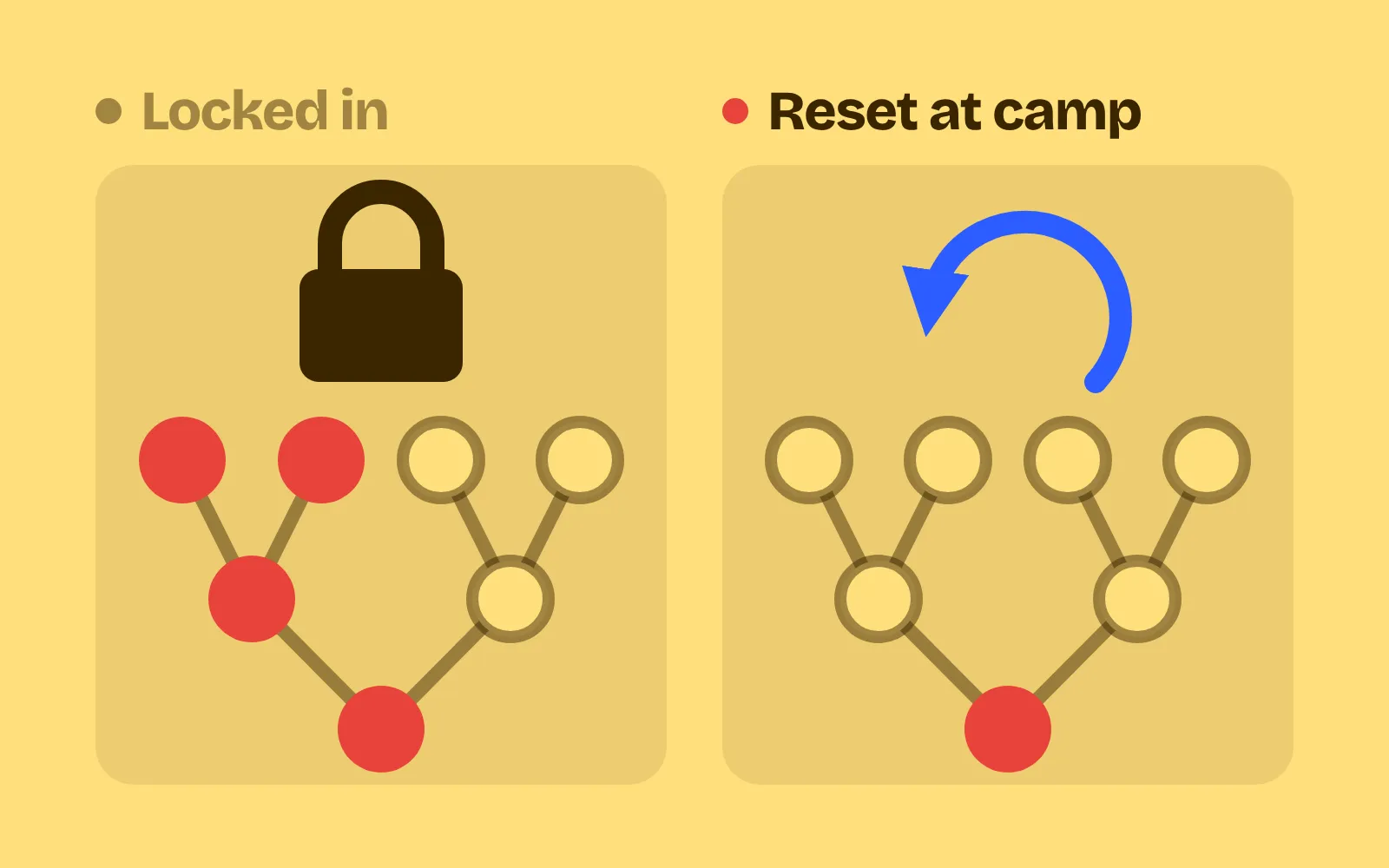
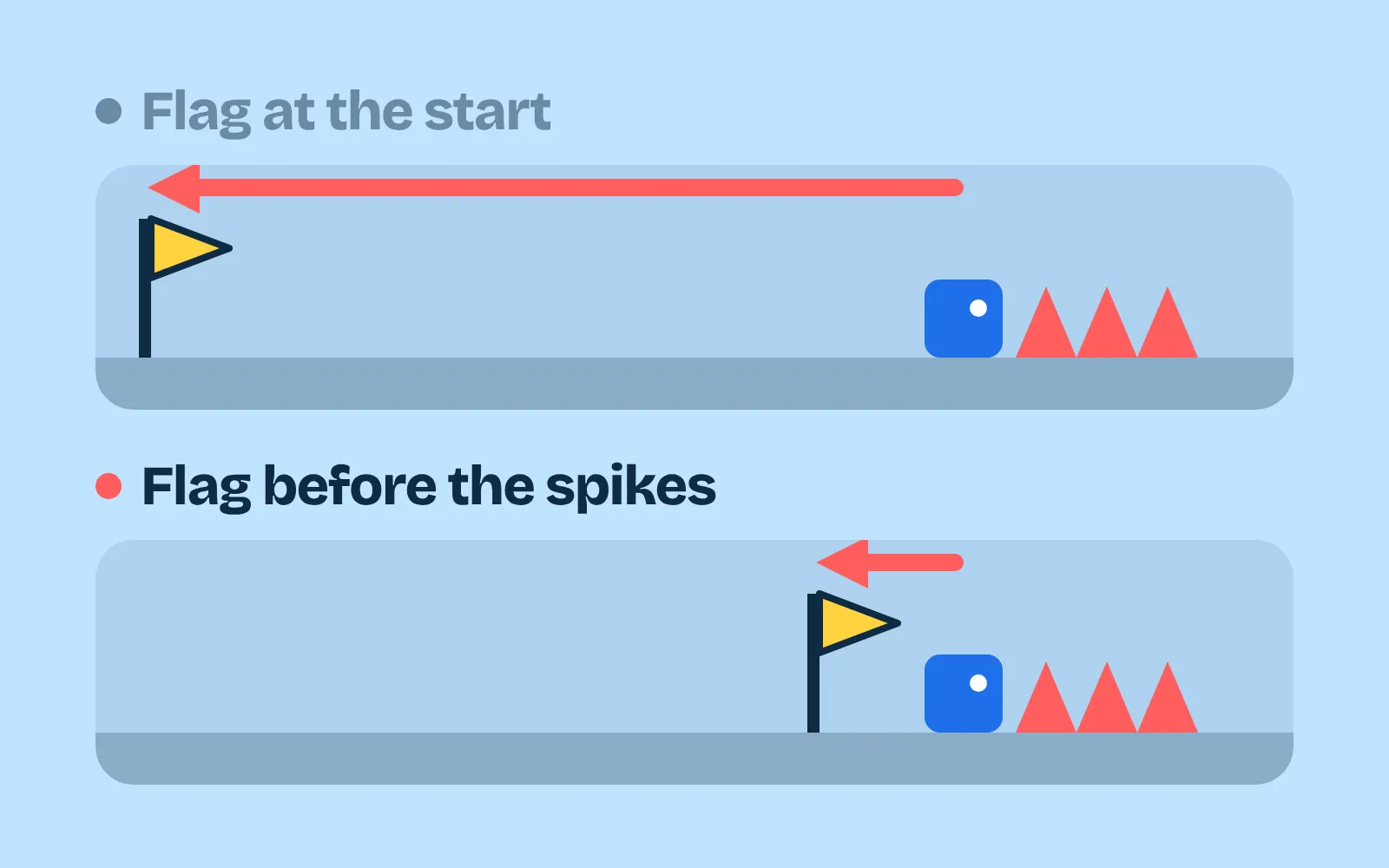
A checkpoint a room early means every death replays the easy room before you get another try at the hard one. Put it one step before the hard spot, and at every boss arena door, and mark it in the world with a flag or a lamp so the player knows where they’ll come back. Elden Ring’s Stakes of Marika are often placed just before boss doors, and if you die nearby you come back beside the stake instead of at the last Site of Grace (Elden Ring Wiki). In our demo, the same death at the spikes costs 4.7 seconds on the left and 1.0 on the right.
2. Split long stretches with a mid-point
Even with a checkpoint at the end, a long stretch before it makes each death expensive. One failure should cost a few minutes at most: about 2 to 3 minutes of replay in platformers and action games, and 5 to 10 in slower ones. Cut longer stretches with a mid-point or a rest room. A Game Developer analysis praises Metroid Prime’s save points “about 10 minutes apart” and criticises a stretch of “over a half hour between save points concluding in a mini-boss” (Game Developer). In our demo, a mid-point flag cuts the replay from 8.3 seconds to 3.3. Our level is seconds long, so scale it up in your head: the same split turns ten minutes of replay into four.
3. Make retry instant
Every second between the death and the next try is a second of waiting with nothing to do. Aim to have the player back in control within about a second: any button skips the death animation, one key restarts. When Meat Boy dies, he “immediately restarts the level” (Wikipedia). Puzzle and strategy games can do the same with undo: Into the Breach lets you reset one turn per battle, according to a Game Informer guide (Game Informer). In our demo, both sides respawn at the same flag. On the left, a death animation, YOU DIED and a Continue menu take 4.1 seconds every time. On the right, you’re back in control in 0.4.
4. Skip the intro on retry
A boss intro is great the first time. The fifth time, it’s a wait between you and the fight. On a retry, skip the intro, the talk before the fight and the walk to the arena, and let every cutscene be skipped. AbleGamers lists this as an accessibility pattern, with Ratchet & Clank as an example: you can pause any cutscene and choose to skip it (AbleGamers). In our demo, the left walks down the corridor and watches a 3.2-second intro after every death. The right respawns at the arena door and the fight starts at once: 7.3 seconds lost per death becomes 1.3.
5. Let the player keep something
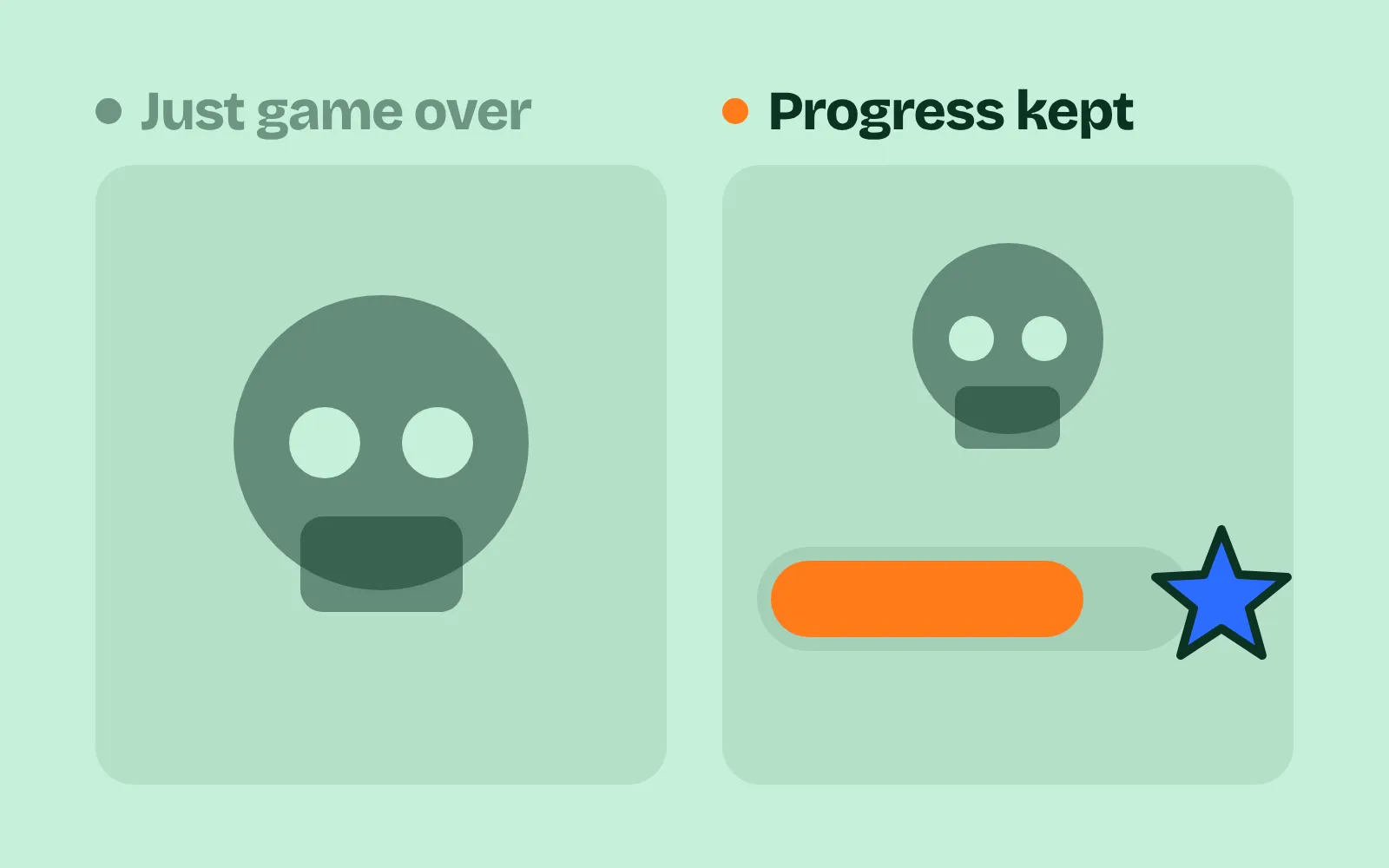
Fast retries make death cheap. Keeping something makes it fair: items, part of the money, XP, or a permanent unlock in a roguelike. It can still have a cost. In Hollow Knight, a Shade carries “all the Geo that was lost upon death”; beat it and you get the Geo back, die again first and it’s gone (Hollow Knight Wiki). In Into the Breach, a pilot sent back in time keeps their experience and abilities (Wikipedia). In our demo, both sides lose the same 4.5 seconds. On the left, the 12 coins you carried are gone for good. On the right, they wait in a bag where you fell.
Cheap, but not free
The goal is to make failure cost seconds, not to remove it. A few rules to keep death meaningful:
- Measure the cost. Play the same hard section 10 times and write down two numbers per death: seconds until you’re back in control, and seconds of replay until you’re back where you died. Replay should stay under a minute per attempt.
- Keep the challenge where it is. Move the checkpoint, not the spikes. The hard part stays exactly as hard.
- Let the player lose what they kept, once. A bag you can lose by dying again gives the next try a small stake. If nothing can ever be lost, death stops mattering at all.
- A wider gap between checkpoints is a choice. It tests “patience and memory as much as it does skill”, as a Game Developer piece on hard modes puts it (Game Developer). Do it on purpose, for a hard mode, not by accident.
If players keep dying in the same place even with cheap retries, the problem is the fight, not the checkpoint. See boss battle design and telegraphed attacks.
Add it to your game
- Copy the skill at the end of this page into your project.
- Ask your agent: “Dying in my game feels too punishing. Fix the checkpoints and retry.”
- Play it, then tune in plain words: “The walk back to the boss is still too long.”
Art in the demos: Pixel Platformer and Kenney Future by Kenney (CC0).
The skill that made it work
This is the whole skill we gave Claude Code. Copy it into your project and ask your agent to make dying cheaper. Every trick sits behind its own switch, and the last step makes it measure the seconds each death costs.
- Find every way to fail (death, lost run, lost match) and what it costs: where the player restarts, what they lose, and every second until play resumes (animation, menu, loading, walk back, cutscene).
- Put every trick behind one named switch in a single settings object, all on by default, so each can be tested on its own.
- checkpoint-before. Put a checkpoint right before each hard spot and at every boss arena door, not a room earlier. Mark it in the world (a flag, a lamp). Elden Ring's Stakes of Marika let you respawn beside them, often just before a boss door.
- split-long. One failure should cost a few minutes at most: about 2 to 3 minutes of replay in platformers and action games, 5 to 10 in slower ones. Cut longer stretches with a mid-point or rest room; in roguelikes and strategy, save between floors or missions.
- instant-retry. Back in control within about a second: any button skips the death animation, one key restarts, puzzle and strategy games get undo. When a state is clearly lost, say so and offer a restart.
- skip-intro. On a retry, skip the boss intro, the talk before the fight and the walk to the arena. Show them once; let every cutscene be skipped.
- keep-on-death. Keep something: items, part of the money, XP, or a permanent unlock in roguelikes. Hollow Knight leaves your lost Geo with a Shade you can beat to get it all back; Into the Breach lets a pilot keep their experience in the next timeline.
- Measure it. Play the same hard section 10 times with tricks on and off. Report seconds from failure to control, seconds of replay before reaching the spot of failure, and attempts to clear. Replay should fall under a minute per attempt.
Save it as .claude/skills/checkpoints-and-retry/SKILL.md in your project. Or connect your agent and type /aigamedev: it loads this skill with its reference files and the results from this post.