Rich with nothing to buy? Game economy design with currency sinks, price scaling and three more tricks
Five game economy design tricks that stop inflation: currency sinks, price scaling, a wallet cap, things worth buying and an inflation check, with simulations side by side.
What we asked“Make a web page that demonstrates the five faucet and sink tricks that keep a game economy from inflating one at a time, so anyone can see and feel each one within a few seconds. For each one, show the same short moment side by side: without it on the left, with it on the right, playing in a loop, with a caption that says what just happened and a replay button. Where it helps, let me play the moment myself. It will sit inside a blog post about 720 pixels wide, so it has to look good at that width and on a phone. Also make each one viewable alone with ?trick=<id>&solo, using these ids: sinks, price-scaling, wallet-cap, worth-buying, inflation-check. Each moment can be a fast simulation of many players over many in-game days, with a live chart of money in circulation and prices on each side. Use the internet freely for better results: free CC0 art, fonts or small libraries (for example Kenney's CC0 assets) are welcome; download anything you use into this folder so the page works without outside links, and list each item with its licence and source in CREDITS.md.”
What happened
- Loaded the economy skill
- Downloaded Kenney's CC0 board game icons and fonts
- Wrote a seeded simulation of 100 players over 30 in-game days, with each trick behind one switch, and checked its numbers before building the page
- Drew live charts of gold in circulation and a price on each side, on the same scale, plus one bar per player's wallet
- Added a Play it yourself tab to four tricks, and a hover readout that shows any day on all four charts
- Swapped the Kenney font out of the numbers, because its “k” looked like an “H”, and checked 720 px, phone width and dark mode
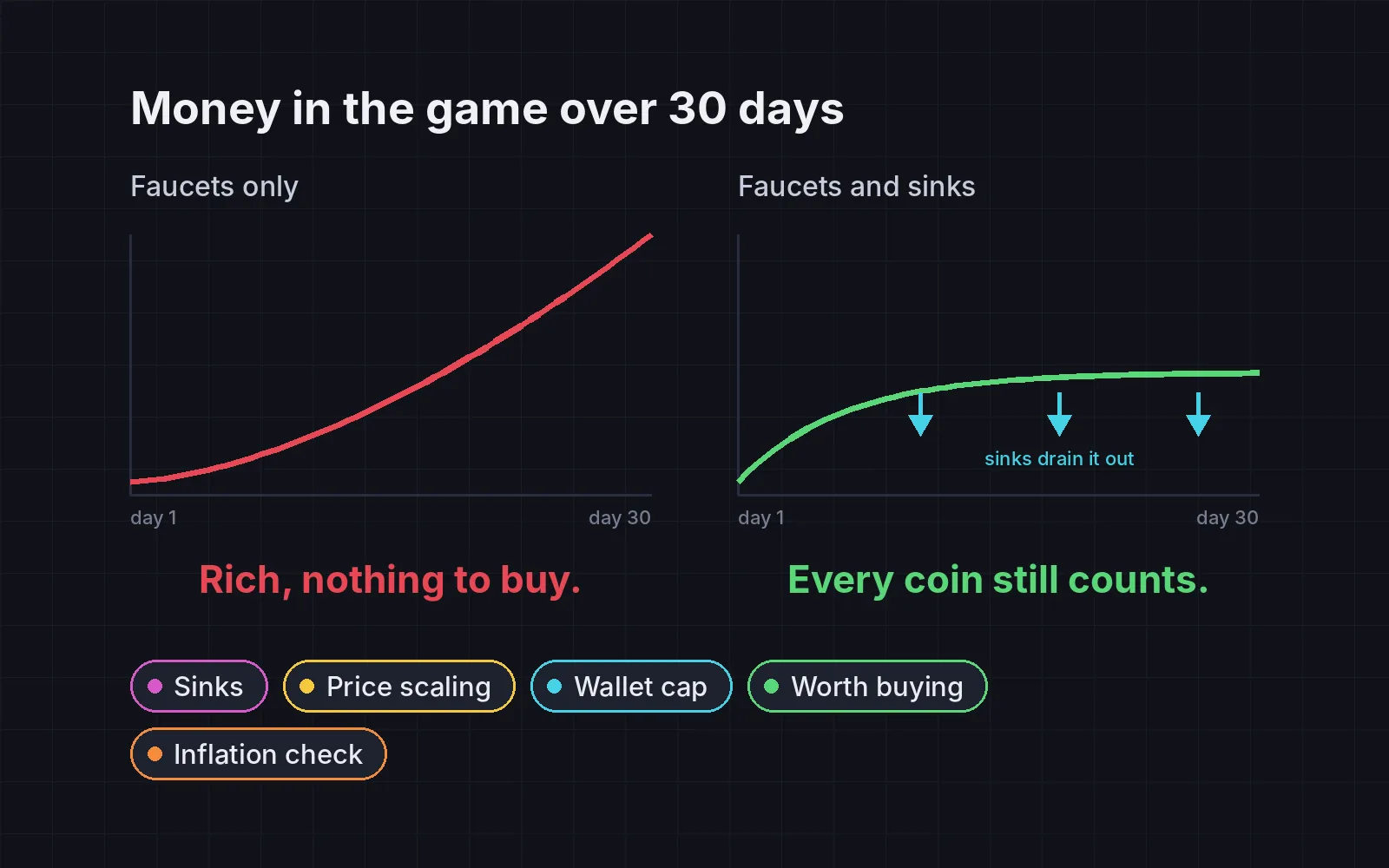
Every coin in your game comes in through a faucet: monster drops, quest rewards, selling loot. If nothing takes coins back out, players pile up gold, prices on the player market climb, and soon everyone is rich with nothing worth buying. Raph Koster described Star Wars Galaxies as a “faucet-drain economy”, where money that goes out “is deleted from the system” rather than going back to a central bank (Raph Koster). Each demo below runs the same simulation of 100 players over 30 in-game days, in about six seconds: without the trick on the left, with it on the right, both on the same scale. Hover or drag on any chart to read off a day. Four of the five have a Play it yourself tab.
1. Sinks that delete gold
A sink destroys currency: repairs, upkeep, fees, consumables, a cut of every trade. Gold that just moves between players is still in the game. Lance Stites of NCsoft, quoted by Simon Ludgate, says that without a drain, inflation would be extreme (Game Developer). World of Warcraft’s auction house is reported to take five percent of every transaction (Engadget). In our demo, without sinks the gold in circulation goes from 350k to 1.2M in 30 days and a potion on the player market from 50 to 132 gold. With repairs, upkeep and a 5% trade cut, gold stays at about 340k and the potion at about 48.
2. Price scaling
When every upgrade costs the same, rising income makes it cheaper and cheaper in play time, until it’s no decision at all. Make each repeat purchase cost more: price(n) = ceil(base × 1.15^n), where n is how many you own. Cookie Clicker raises each building’s price by 15% per purchase, rounded up (Cookie Clicker Wiki). Here pickaxes raise income, and one in-game day is one hour of play. With a flat price of 400, the next pickaxe costs 7 minutes of play by day 30 and 3.5M gold piles up. With scaling, it costs 192 minutes and only 199k gold is left in circulation. That’s more than the start (80 minutes); if you want the cost to stay steady, lower the 1.15.
3. A wallet cap
Cap how much one player can hold, and show the cap in the UI so hoarding has a ceiling and prices can be planned. Destiny 2 has one for glimmer, and news sites reported it rose from 100,000 to 250,000 with Shadowkeep (Mein-MMO). In our demo, five gold farmers earn nine times what everyone else does. Without a cap they push the rare mount on the auction house to about 21k gold. With a visible 15k cap, the mount stays near 7.5k. In Play it yourself, you grind for the mount while a farmer outbids you.
4. Things worth buying
A sink players want works better than a tax they resent. Put big goals in sight from the start: a mount, a house, flying, cosmetics. World of Warcraft’s flying skill originally cost 5,000 gold to train, Engadget reports (Engadget). In our demo, a shop that only sells potions gets 15% of earned gold spent, and the median wallet sits there with nothing to buy. With the goals added, 75% gets spent. The darker wallet bars show players who own more goals.
5. An inflation check
You can’t fix inflation you aren’t measuring. Log three numbers over time: the total money in the game, the median wallet, and the price of a fixed basket of useful items. CCP publishes a monthly economic report for EVE Online with sink and faucet charts and the money supply (EVE Online). Both sides here start with no sinks. On the left, nobody logs anything, and the charts only show what was missed on day 30. On the right, the basket price rises 25% in a week, an alarm fires on day 5, and sinks switch on. This one is watch only.
How to tune it
The goal isn’t to make players poor. It’s to keep the next thing worth wanting a few purchases away.
- Sinks should feel like a choice. Fast travel, cosmetics and upkeep on things players love go down better than a tax on everything.
- Watch the play time, not the price. A price that rises 15% each time can still get cheaper to earn, or much more expensive, depending on income. Check how many minutes of play the next purchase costs.
- Aim for a level line. With the tricks on, money in circulation should level off instead of climbing forever, and the median wallet should stay within a few purchases of the next goal.
Where the money comes from matters too: see the XP curve formula and the roguelike upgrade system.
Add it to your game
- Copy the skill at the end of this page into your project.
- Ask your agent: “Stop my game’s economy from inflating.”
- Play it, then tune in plain words: “Repairs cost too much in the first hour.”
Art in the demos: Board Game Icons and Kenney Mini from Kenney Fonts by Kenney (CC0).
The skill that made it work
This is the whole skill we gave Claude Code. Copy it into your project and ask your agent to keep your currency meaningful. Every trick sits behind its own switch, and the last step makes it simulate 100 players over 30 days instead of guessing.
- Find every faucet and every sink: where currency is created, where it is destroyed, and where it only moves between players.
- Put every trick behind one named switch in a single settings object, all on by default, so each can be tested on its own.
- sinks. Give every faucet sinks that destroy currency: repairs, fees, consumables, fast travel, a cut of every trade. World of Warcraft's auction house takes 5% of every transaction.
- price-scaling. Make repeat purchases and upgrades cost more each time:
price(n) = ceil(base * 1.15^n), where n is how many you own. Cookie Clicker raises every building's price by 15% per purchase. - wallet-cap. Cap how much one player can hold and show the cap in the UI, so hoarding has a ceiling and prices can be planned. Destiny 2 raised its glimmer cap from 100,000 to 250,000 with Shadowkeep.
- worth-buying. Put big goals in sight from the start: cosmetics, mounts, housing, rare upgrades. A sink the player wants works better than a tax they resent. World of Warcraft's flying skill originally cost 5,000 gold to train.
- inflation-check. Log three numbers over time: total money in the game, the median wallet, and the price of a fixed basket of useful items. EVE Online publishes a monthly economic report with sinks and faucets and money supply charts.
- Measure it. Simulate 100 players for 30 in-game days with tricks on and off. Report total money supply per day, the median wallet compared to the price of the next goal, and the share of earned money that was spent. With the tricks on, supply should level off instead of climbing forever, and the median wallet should stay within a few purchases of the next goal.
Save it as .claude/skills/economy/SKILL.md in your project. Or connect your agent and type /aigamedev: it loads this skill with its reference files and the results from this post.