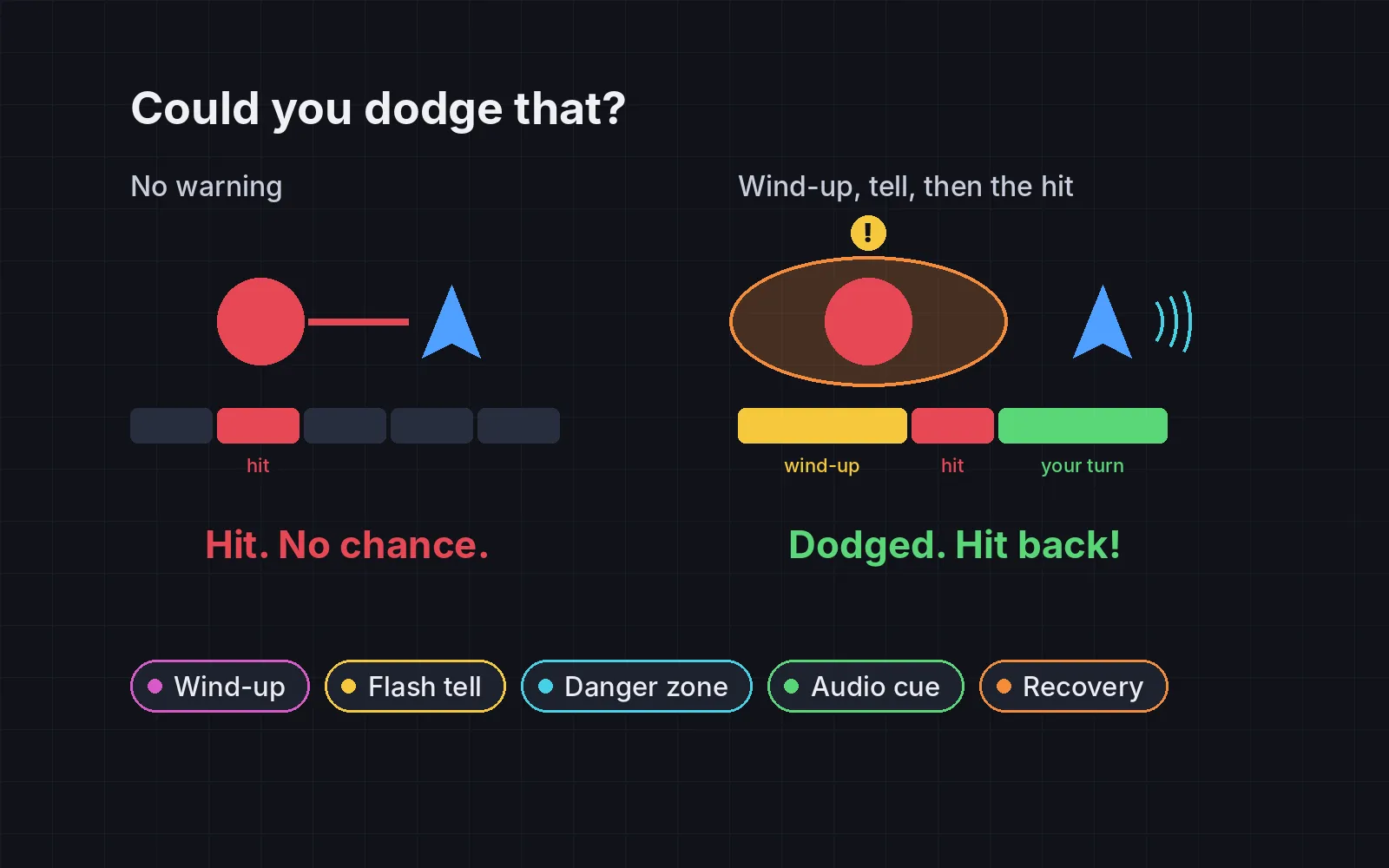
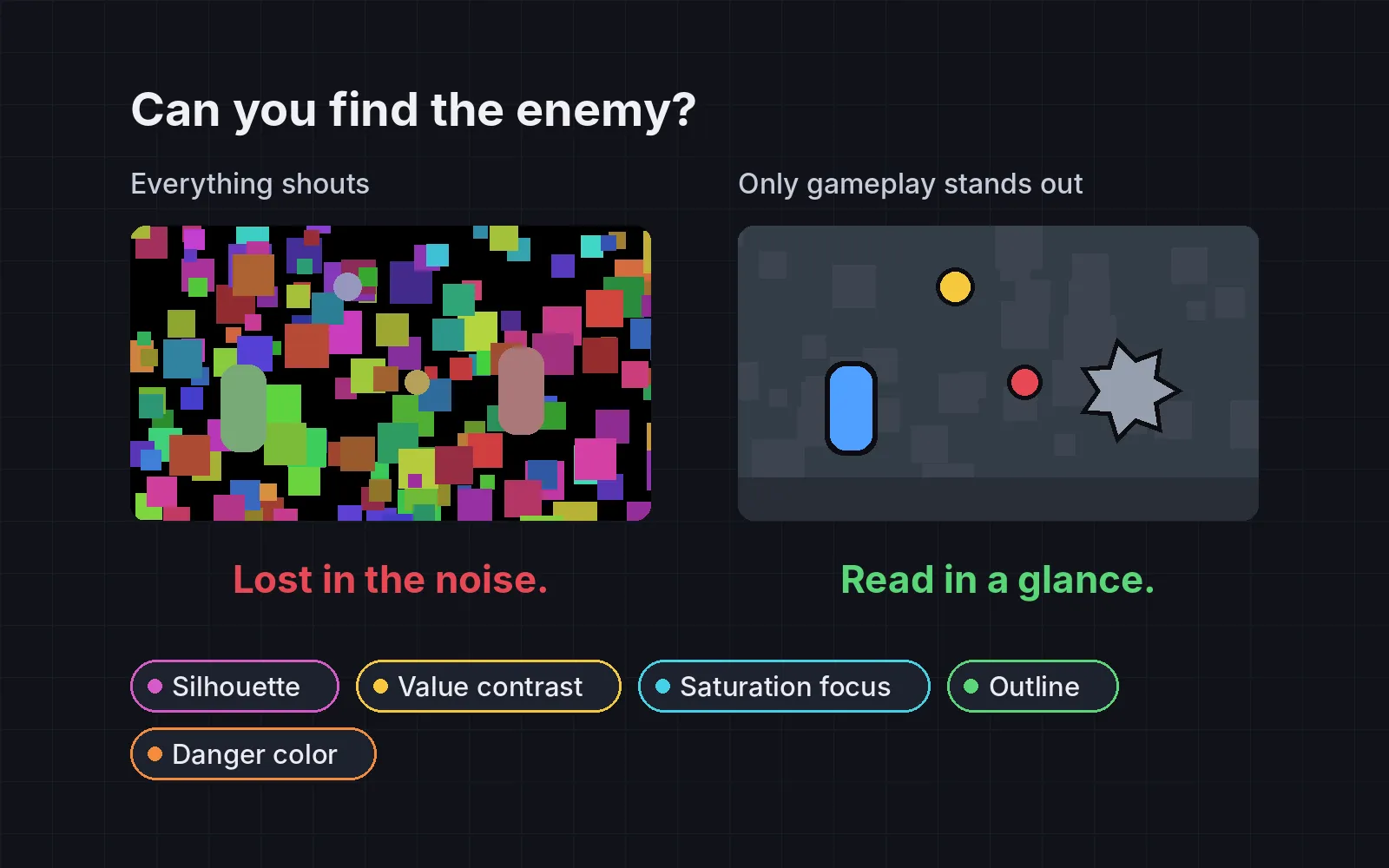
Games secretly cheat for you: 5 hidden mercy tricks, and how to add them to yours
Your last bit of health lasts longer than the bar says, and the first bullet aimed at you misses on purpose. Watch each trick side by side, with and without it, then add them to your game.
What we asked“Make a web page that demonstrates the hidden mercy tricks one at a time, so anyone can see and feel each one within a few seconds. For each trick, show the same short moment side by side: without the trick on the left, with it on the right, playing in a loop, with a caption that says what just happened and a replay button. Where it helps, let me play the moment myself.”
What happened
- Loaded the hidden-mercy skill
- Wrote one page where both sides run the same little simulation, so the trick is the only difference
- Scripted a five-second moment for each trick and checked, run by run, that it plays out the way its caption says
- Tuned each moment until all five matched their captions
- Checked it in a real browser at 720 pixels and at phone width, and fixed labels that covered the exits
- Added "Play it yourself": you steer, and both sides get exactly the same input
Many games quietly help you when you are about to lose, so that you just survive and feel great about it. Players never notice, and that is the point. Here are five of these tricks. Each demo below plays the same moment twice: without the trick on the left, with it on the right. Press Play it yourself to steer; both sides copy your moves, so the trick is the only difference.
1. Last sliver
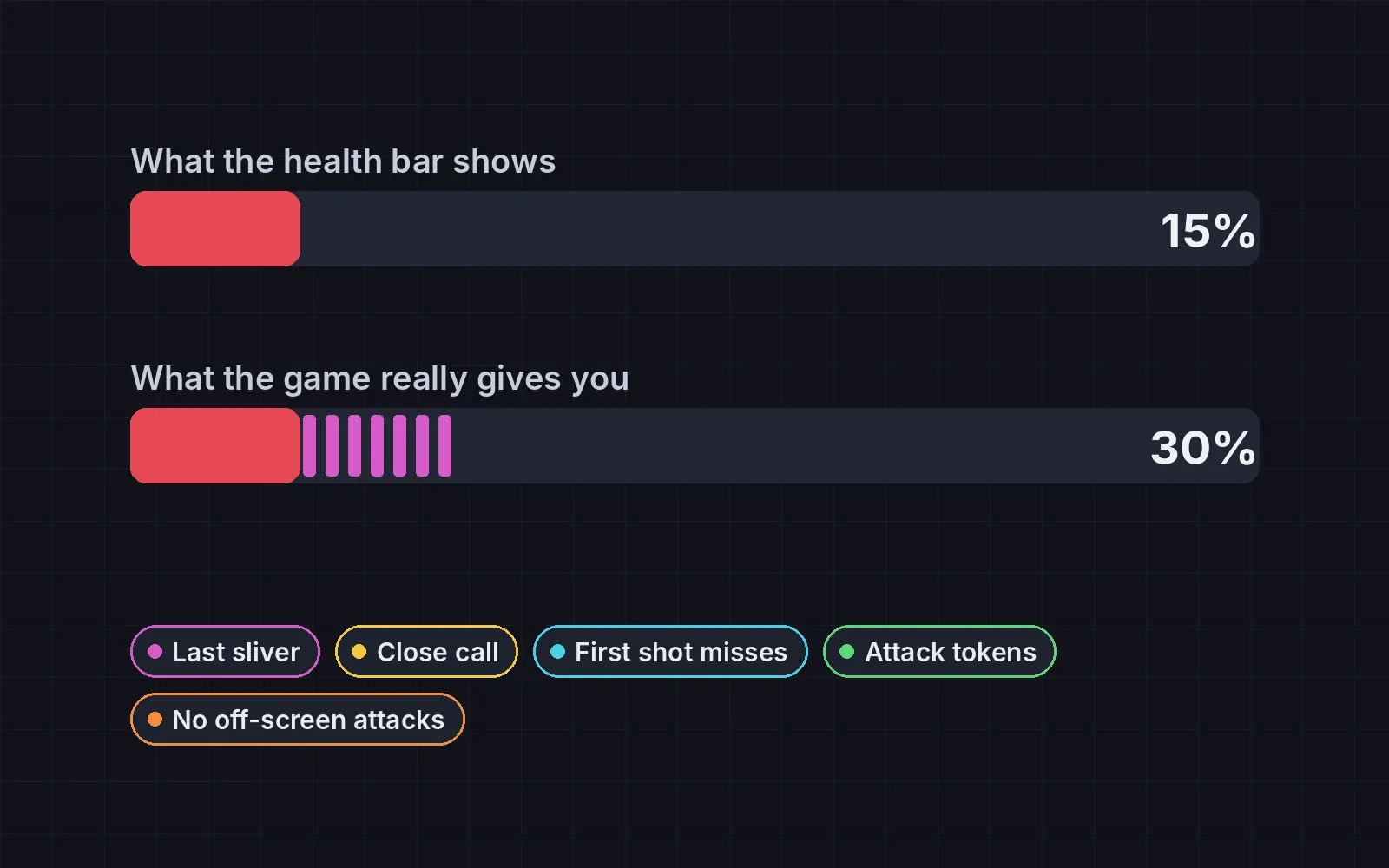
In some games the last part of your health bar holds more health than it shows. Game designer Jennifer Scheurle started a thread of developers sharing tricks like this in 2017, and Assassin’s Creed and Doom were named for it (PC Gamer). Here, damage is halved below 25%, so the last quarter lasts twice as long.
2. Close call
A hit that should kill you leaves you alive for a moment instead. The same thread said BioShock gives you one to two seconds of invulnerability when you take damage at very low health (PC Gamer).
3. First shot misses
BioShock’s enemies are said to miss with their first bullets, giving you a head start without you knowing (Kotaku). The miss has to be close, so it still feels like danger.
4. Attack tokens
When many enemies surround you, only a few actually attack. Developer Tom Forsyth described Half-Life sending only two enemies at you at once while the rest run around shouting things like “flanking!” (Kotaku). The fight looks huge but stays readable.
5. No off-screen attacks
Getting hit by something you could not see feels unfair, not hard. Devil May Cry is said to slow down or stop enemies that are off screen (GamesRadar). The bright frame is what the player can see; the dark area is off screen.
Does it actually help?
In a full arena game with a switch for every trick, another Claude Code session had a bot play the same 100 fights with every trick on and with every trick off:
| Time survived | Deaths | |
|---|---|---|
| All tricks on | 162 s | 98 of 100 |
| All tricks off | 116 s | 100 of 100 |
The bot lives about 40% longer, but it still loses almost every time. That is the balance you want: the game is kinder, not easier to win.
Add it to your game
- Copy the skill at the end of this page into your project.
- Ask your agent: “Add hidden mercy to my game.” It works for shooters, action games and platformers with enemies.
- Play it, then tune the numbers in plain words: “The last sliver is too generous.”
A few rules from the developers who use these tricks:
- Never show it. If players learn the bar lies, they stop trusting it, and the trick stops working. The labels in these demos are only for this page.
- Keep it small. Mercy should turn a sure loss into a close win, not remove losing.
- Keep a switch for each trick. Then you can test without it, and turn it off for a hard mode.
The skill that made it work
This is the whole skill we gave Claude Code. Copy it into your project and ask for hidden mercy in your own game. The last step makes the agent measure that the tricks help instead of guessing.
- Find where the player takes damage, where each enemy decides to attack, and where enemies aim their shots.
- Put every trick behind one named switch in a single settings object, all on by default, so each can be tested on its own.
- Last sliver. When the player's health is below 25%, scale incoming damage down (about x0.5) so the last quarter of the bar lasts about twice as long. Never change what the health bar shows.
- Close call. When a hit would kill a player who had more than 10% health, leave them at 1 HP instead and give 1.5 seconds of invulnerability with a clear flash. At most once every 10 seconds.
- First shot misses. An enemy's first shot after it notices the player is aimed slightly off, so it passes close enough to be seen and heard, then normal aiming resumes.
- Attack tokens. At most 2 enemies may attack at the same time. An enemy needs a token to fire or lunge, returns it when the attack ends, and waits a short moment before taking another. Enemies without a token keep moving and threatening.
- No off-screen attacks. Enemies outside the camera view, or behind the player in first person, do not start attacks.
- Measure it. Run the same fights automatically with a fixed random seed and a simple scripted player, once with all tricks on and once with all off. Report time survived, damage taken and close calls. With the tricks on, the scripted player should survive clearly longer. If it doesn't, the numbers are too small; if it never dies, they are too big.
Save it as .claude/skills/hidden-mercy/SKILL.md in your project. Or connect your agent and type /aigamedev: it loads this skill with its reference files and the results from this post.