Growing a game: adding a spring pad across six rooms with Claude Code
We asked Claude Code to add a second area to our platformer that brings in one new thing, a spring pad. See the plan of all 12 rooms, play the game and see what we measured.
Before you start
- The six-room level from part 4, or any Phaser platformer that keeps its rooms as data.
- Claude Code, started in the game's folder.
- The updated skill at the end of this page, in the folder's .claude/skills/platformer-levels/. Then type the prompt below.
What we asked“Add a second area of about six rooms that brings in one new thing: a spring pad that bounces the player high. Teach it the way the first area teaches the jump, mix it with the double jump, and end the area with a room that tests both.”
What happened
- Used the platformer-levels skill
- Read index.html and the skill's notes on room stories, teaching, checking and progression
- Checked that a headless browser can run the game
- Added the spring pad as tile letter S
- Worked out the reach: jump 107 px, double jump 192 px, spring bounce 349 px
- Wrote six area 2 rooms as text grids, each with a one-line story
- Measured the spring in the running game
- Changed the cap so it only limits falling
- Retimed the routes for rooms 11 and 12: all 12 rooms passed
- Ran each new room 50 times with simulated new, average and skilled players
- Switched its test inputs from real time to game frames
- Lowered the spring from 1000 to 900 px/s so a double jump at the top of the bounce no longer hits the top of the screen
- Rebuilt the area 2 rooms around the lower bounce
- Swept the timing windows in rooms 9 to 12
- Ran the simulated players again: area 2 at 50 runs each, area 1 at 30
- Made rooms 9, 11 and 12 harder: a wider pit, a shorter ledge and a one-tile pillar
- Played all 12 rooms with the scripted routes on the finished file
- Saved a picture of the six new rooms
A demo can be one good room. A game has to keep giving the player something new, one thing at a time, and each new thing needs its own short arc: you meet it where failing costs nothing, use it with some risk, see it used in a way you didn’t expect, then prove you have it. Koichi Hayashida, who directed Super Mario 3D Land, describes this arc as kishōtenketsu (introduce, develop, twist, conclude). We added it to our platformer-levels skill and asked Claude Code to grow part 4’s six-room level into a second area built around one new thing, a spring pad.
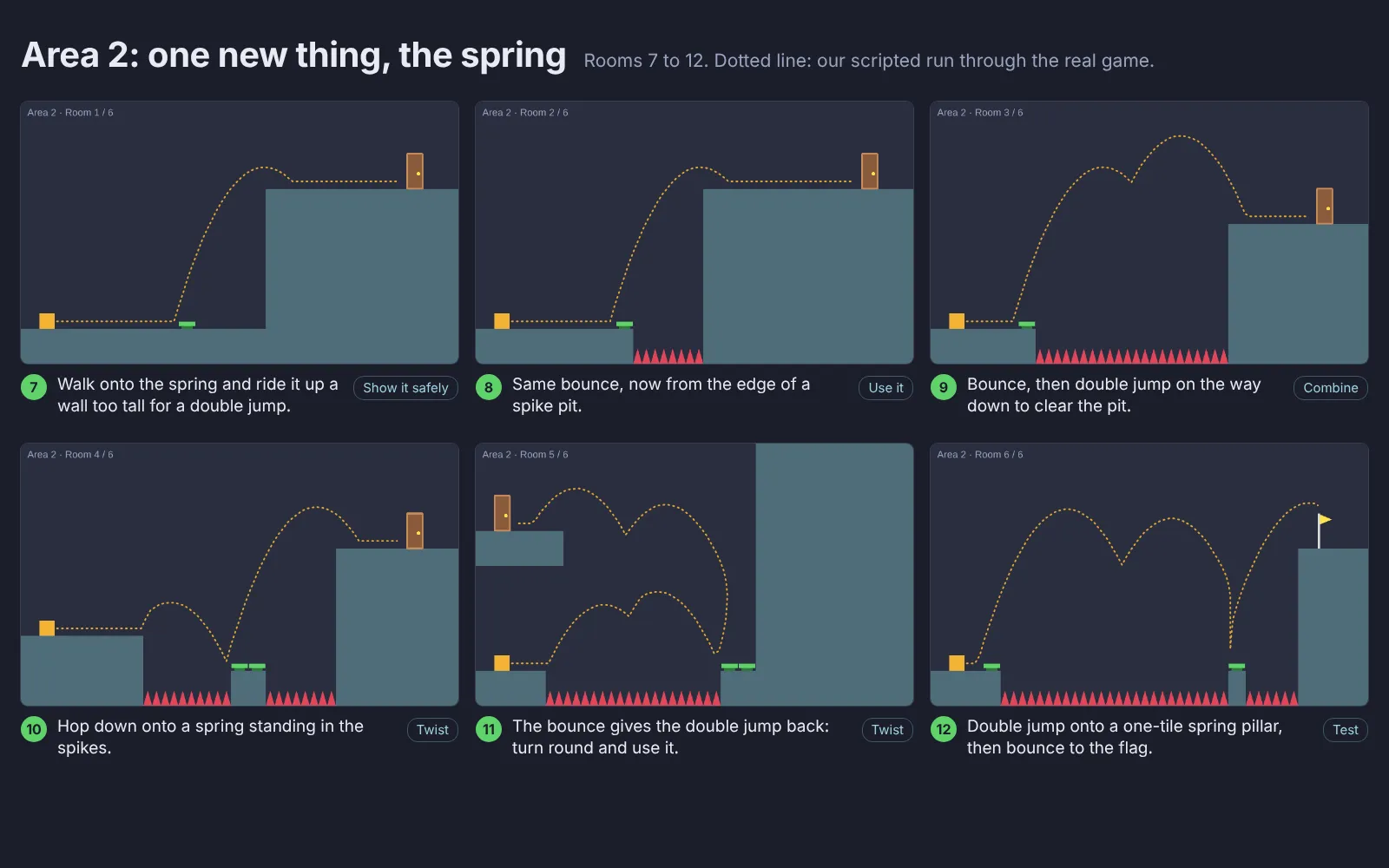
This is the plan of the whole game as Claude left it. Rooms run across and elements run down. Tap a room to see its layout and our scripted run through it.
Layouts and stories come from Claude's level file, and the dotted paths are our scripted runs. Area 2's beats are Claude's own labels; area 1's come from part 4's table. Grey dots mark an older move a room still needs, from our runs. "Our demo: 1 room" shows the single room from parts 1 to 3.
Read the grid from left to right and the elements arrive one at a time. Area 1 brings in the jump and then the double jump. Area 2 brings in only the spring, takes it through all four beats in six rooms, and brings the double jump back in rooms 9, 11 and 12. Room 12 tests both.
Claude's game. The game has no way to skip ahead, so area 2 starts after the six rooms of area 1 (our scripted run takes 16 seconds there). Spikes restart the room you're in. We only added the start screen and loaded Phaser from this site.
| Room | Claude’s label | Story (from Claude’s level file) | What we measured |
|---|---|---|---|
| 7 | Show it safely | Walk onto the spring and ride it up a wall far too tall for a double jump (falling is safe). | No jump press needed. The wall is 256 px, out of reach of a double jump (192 px). |
| 8 | Use it | Run onto the spring at the edge of a spike pit and keep holding right to ride the bounce onto the high ledge. | Same input as room 7, now with spikes below. 72% of the bounce’s reach. |
| 9 | Combine | Bounce off the spring, then double jump on the way down to carry over a spike pit too wide for the bounce alone. | The bounce alone would need 146%. With the double jump it’s 86%, pressed any time from the top of the bounce to 0.47 s after. |
| 10 | Twist | Hop off the ledge onto the spring standing in the spikes and let it throw you up to the far ledge. | Walking off the ledge misses the spring. Without the spring, the best double jump falls 56 px short. Bounce: 77%. |
| 11 | Twist | Double jump over the pit onto the spring by the wall; its bounce gives the double jump back, so turn round and use it again to reach the ledge above the start. | 77% to reach the spring, then 80% back to the ledge with the double jump the bounce gave back. Without it, 175%. |
| 12 | Test | Run onto the spring, double jump at the top to land on the one-spring pillar far across the spikes, then bounce up to the flag. | 85% to reach the one-tile pillar. To land on it you let go of right within a 56 px stretch, about 0.2 s. |
We measured with Playwright in headless Chrome, stepping the game at a fixed 60 fps. Walking onto the spring throws the square 282 px up, 2.6 times a jump, and a double jump at the top takes it to 367 px. Running onto it carries you 334 px across flat ground, or 524 px with the double jump. Each share in the table is the jump a room needs, compared with that reach at the same height and counting the square’s 28 px width. Our scripted run finished all 12 rooms in one go with no deaths, in about 33 seconds. Rooms 1 to 6 have no springs, so nothing needs the spring before room 7 shows it. With the air jump switched off, rooms 9, 11 and 12 can’t be finished.
Claude’s own shares are within a few points of ours (it gives 79% for room 10 and 85% for room 11). It also found the biggest problem without our help. Its first spring launched at 1000 px/s and rose 349 px, so close to the top of the screen that a double jump at the top of the bounce hit the ceiling and fell short. We saw the same thing in that version: room 12 only worked if you waited about 0.2 s after the top. Claude lowered the spring to 900 and rebuilt the rooms. In the final room 12, the double jump works from the top of the bounce to 0.65 s after it.
The weak part was time. The new progression notes in the skill ask for every room to be run about 50 times with simulated new, average and skilled players. Claude ran those simulations three times: after building the rooms, after lowering the spring, and after making rooms 9, 11 and 12 harder. The session took 2 hours 4 minutes, most of it waiting for those runs on a two-CPU machine that our own measurements were sharing for part of the time. It cost $3.83, where part 4 took 17 minutes and $1.19. Even after the last round, Claude’s report says rooms 9 to 11 are easier than the skill’s targets. It chose to leave them, and the area ends on the test with no calm room after it, because the prompt asked for that.
Get the skill. It works for Phaser, Godot, Unity or plain canvas platformers. You can also install all seven skills as a Claude Code plugin or replay this part from its starting files.
The next part measures how hard each room is for a player who gets better as they go.
Recorded with a clean Claude Code: no personal skills, plugins or MCP servers. The session had platformer-levels and our earlier platformer-feel skill installed.
The skill that made it work
It makes Claude plan the whole game in areas, bring in one new element per area through introduce, develop, twist and test, and check every room against the game's own jump numbers.
- Keep levels as data: each room in a small grid or list (tiles, hazards, pickups, start, exit), separate from the game code.
- Write each room's one-line story first: one sentence about the single thing the room asks of the player. Build only what serves it.
- Teach in order, without text: each new move or object is shown safely, then used, combined and tested.
- Check every room with the jump numbers: work out from the game's constants how far and how high the player can jump, check every required jump and every tempting wrong jump, then play each room with a scripted route.
- Plan the whole game, not just a room: bring in one new element per area through introduce, develop, twist and test, and measure every room with simulated players of different skill so the difficulty rises in waves.
- Report like a level designer: for each room, its story, what it teaches, its hardest jump as a share of the maximum, and whether the scripted route finished.
Save it as .claude/skills/platformer-levels/SKILL.md in your project.
Was this useful?
Thanks, we read every message.
Part 5 of Make a complete platformer with AI