Safe or greedy? Risk reward game design with push-your-luck, greed timers and three more tricks
Five risk and reward tricks that give players real choices: a risky route, push-your-luck banking, a greed timer, combo cash-out and visible stakes, each shown side by side.
What we asked“Make a web page that demonstrates the five risk and reward tricks that make players weigh safe against greedy play one at a time, so anyone can see and feel each one within a few seconds. For each one, show the same short moment side by side: without it on the left, with it on the right, playing in a loop, with a caption that says what just happened and a replay button. Where it helps, let me play the moment myself. It will sit inside a blog post about 720 pixels wide, so it has to look good at that width and on a phone. Also make each one viewable alone with ?trick=<id>&solo, using these ids: risky-route, push-luck, greed-timer, combo-cashout, visible-stakes. Where the trick is a choice, run quick simulated players through it and show the score spread of safe and greedy play under each side. Use the internet freely for better results: free CC0 art, fonts or small libraries (for example Kenney's CC0 assets) are welcome; download anything you use into this folder so the page works without outside links, and list each item with its licence and source in CREDITS.md.”
What happened
- Loaded the risk-reward skill
- Downloaded Kenney's Tiny Dungeon sprites and the Kenney Mini font
- Wrote one shared set of rules and three simulated players, then tuned the numbers until each choice was real
- Built the five moments, the score charts and the page
- Fixed a thin line between tiles by drawing each static background once
- Checked screenshots at 720 px and 375 px in light and dark themes, and clicked through every play mode with no script errors
If one option is always best, it isn’t a choice. Players find it, take it every time, and every run plays the same. A good risk is one where the safe option is fine and the greedy one is tempting, and the player can see what’s at stake. Dark Souls is the classic example: when you die you drop your souls, and you can get them back by reaching your bloodstain, but if you die again first they are gone for good (Wikipedia). Every trip back is a decision.
In each demo below, the left side plays without the trick and the right side with it. The loops change each time round, so you see the risk pay off and then cost something. Play it yourself makes both sides playable. Under each demo, three simulated players ran 1,000 runs on each side: one always plays safe, one always goes greedy, and one is sensible and only takes risks it can afford. The charts show how their scores spread.
1. A risky route
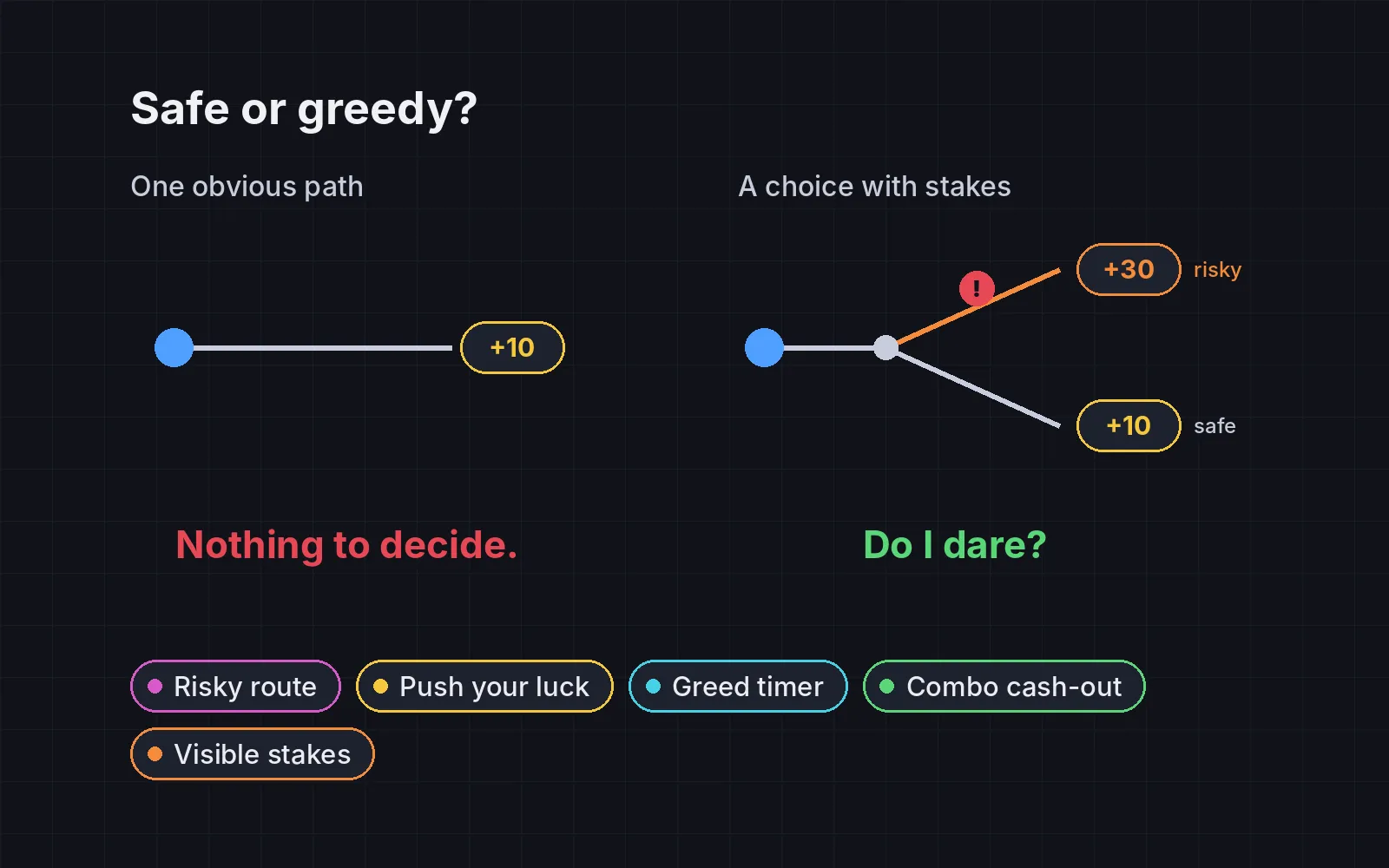
Next to the safe path, offer an optional harder one that pays about 1.5 to 3 times as much, clearly marked before the player commits. Slay the Spire marks elite fights separately on its map, and beating one gives a relic, 25 to 35 gold and a card, according to the fan wiki (Slay the Spire Wiki). In our demo the safe road pays +10 with a 10% chance of a hit, and the spike road pays +25 (2.5 times) with a 50% chance. Without the second road, all three players average 59. With it, the sensible one averages 86, the greedy one reaches 150 but dies in 64% of runs, and the safe one almost never dies but stays at 59.
2. Push your luck
Let the player keep going while an unbanked pile grows, each step riskier than the last, and let them bank whenever they like. A failure loses only the unbanked pile, never what is already safe. A good starting point: each step adds the same reward and about 8% more chance to fail. In our demo, chest number k is a mimic 8% × k of the time. Without the trick, every chest banks at once, nothing is at stake, and nobody ever stops. With it, the player who banks after 3 chests averages 88, the one who pushes to 6 hits 180 at best but busts 87% of the time, and the one who banks after 2 is safest but averages 78.
3. A greed timer
Let the player stay to collect more, but show a clock, and when it runs out send a threat that pushes them on. In Spelunky HD, a ghost arrives after 2 minutes 30 seconds on a level and chases you, and it is nearly impossible to hurt (Spelunky Wiki). In our demo, coins keep appearing; on the right, a ghost comes when the clock hits zero at 10 s, and its chance to catch you grows by 8% for every second you stay past that. Leaving at 11 s averages 303. Staying to 14 s gives the best single run (480) but loses the haul 61% of the time.
4. Combo cash-out
Put the points from a chain into a pot multiplied by the chain length, and add the pot to the score only when the player ends the chain safely. Getting hit empties it. Tony Hawk’s Pro Skater raises a combo’s multiplier by one for each trick, so a kickflip and a heelflip earn 200 × 2 (StrategyWiki). The “hit empties the pot” part is our design rule, not a claim about that game. In our demo, the timing window narrows with each hit: a swing misses 5% of the time, plus 3% for every hit already in the chain. Cashing out at 5 hits averages 918. Pushing to 9 reaches 2,430 but drops the pot 84% of the time.
5. Visible stakes
Before the player commits, show both sides of the deal in numbers: “+40 gold / 30% trap: −1 heart”. Then a loss feels like a bet they made, not a cheat. Dead Cells’ cursed chests are a clear deal: the curse lasts 10 kills, and nearly any hit while cursed kills you (Dead Cells Wiki). This trick behaves differently from the other four. With the deal hidden, the greedy player wins on average (162 against 143), because careful play has nothing to go on: it’s a blind gamble. With the deal on the lid, the sensible player, who reads it and checks their health, comes out on top with 176.
Is the choice real?
Before you ship a risk, check it with three simulated players: always safe, always greedy, and sensible. A real choice looks like this:
- The sensible player averages highest.
- The greedy player has the best single runs and loses most often.
- The safe player loses least but scores lower.
If one player wins on every number, the choice is fake: everyone will learn to play that way. Two more things we learned from the demos. The numbers in them (+8% per step, 2.5 times the reward) are starting values, not taken from any game, so tune them against the charts. And the versions without the tricks sometimes score higher in total, because nobody is ever punished. Compare the shape of the scores, not the totals.
A risk is one kind of choice. For choices the story remembers, see meaningful choices in games.
Add it to your game
- Copy the skill at the end of this page into your project.
- Ask your agent: “Every run plays the same. Give players real choices between safe and greedy play.”
- Check its report, then tune in plain words: “Greedy wins too often, make the spike road hurt more.”
Art in the demos: Tiny Dungeon and Kenney Fonts by Kenney (CC0).
The skill that made it work
This is the whole skill we gave Claude Code. Copy it into your project and ask your agent to give players real choices. Every trick sits behind its own switch, and the last step runs 1,000 simulated runs to check the choice matters.
- Find where the player gains something (loot, score, XP) and where they can lose it (death, damage, time).
- Put every trick behind one named switch in a single settings object, all on by default, so each can be tested on its own.
- risky-route. Next to the safe path, offer an optional harder one, clearly marked before the player commits, that pays about 1.5 to 3 times as much. Slay the Spire marks elite fights separately on the map; beating one gives a relic and 25 to 35 gold.
- push-luck. Let the player keep going while an unbanked pile grows, each step riskier (for example +1 reward and +8% chance to fail per step), and let them bank at any time. Failure loses only the unbanked pile, never what is already safe.
- greed-timer. Let the player stay to collect more, but show a clock, and when it runs out send a threat that pushes them on. Spelunky HD's ghost arrives after 2 minutes 30 seconds on a level.
- combo-cashout. Put points from a chain into a pot multiplied by the chain length, and add the pot to the score only when the player ends the chain safely; getting hit empties it. Tony Hawk's Pro Skater raises a combo's multiplier by one for each trick.
- visible-stakes. Before the player commits, show both sides in numbers ("+1 relic / -25% HP"). Dead Cells' cursed chests are a clear deal: the curse lasts 10 kills, and almost any hit taken while cursed kills you.
- Measure it. Simulate 1,000 runs each for three bots: always safe, always greedy, and risky only when healthy. With the tricks on, the sensible bot should score best on average, the greedy one should have the highest peaks and most deaths, and the safe one should finish most but score lower. If one bot wins on every number, the choice is fake.
Save it as .claude/skills/risk-reward/SKILL.md in your project. Or connect your agent and type /aigamedev: it loads this skill with its reference files and the results from this post.