Inventing sushi with flavour rules from real chefs: a crafting system you can learn
One prompt and a skill turned our card packs into ingredients: combine rice, toppings, sauces and preparations into your own sushi. 26 rules from Edomae chefs decide what's great and what's a disaster, and every try teaches one. Part 3. Make a dish.
What we asked“Let players invent their own sushi in Neta. Instead of each card being one fixed nigiri, the cards become ingredients: rice, toppings, sauces, garnishes and preparations like torching or kelp curing. Players combine them on a prep board into new dishes that go on the menu. Some combinations should be great and some bad, players should be able to learn why, and customers should react to what they're served.”
What happened
- Loaded the sushi-crafting skill and read the game from part 2
- Gave all 27 toppings flavour numbers and tags (fatty, delicate, strong, smoky…), and added 17 ingredient cards: forms, rices, preparations, sauces and garnishes
- Wrote the scorer: 26 rules, each with the chef practice it comes from
- Scored all 27,135 possible dishes and checked that every card helps somewhere and hurts somewhere
- Built the prep board with four views: board, result, menu and journal
- Put invented dishes on plates and in order bubbles, and gave customers reactions like SMOKY! and TOO FISHY
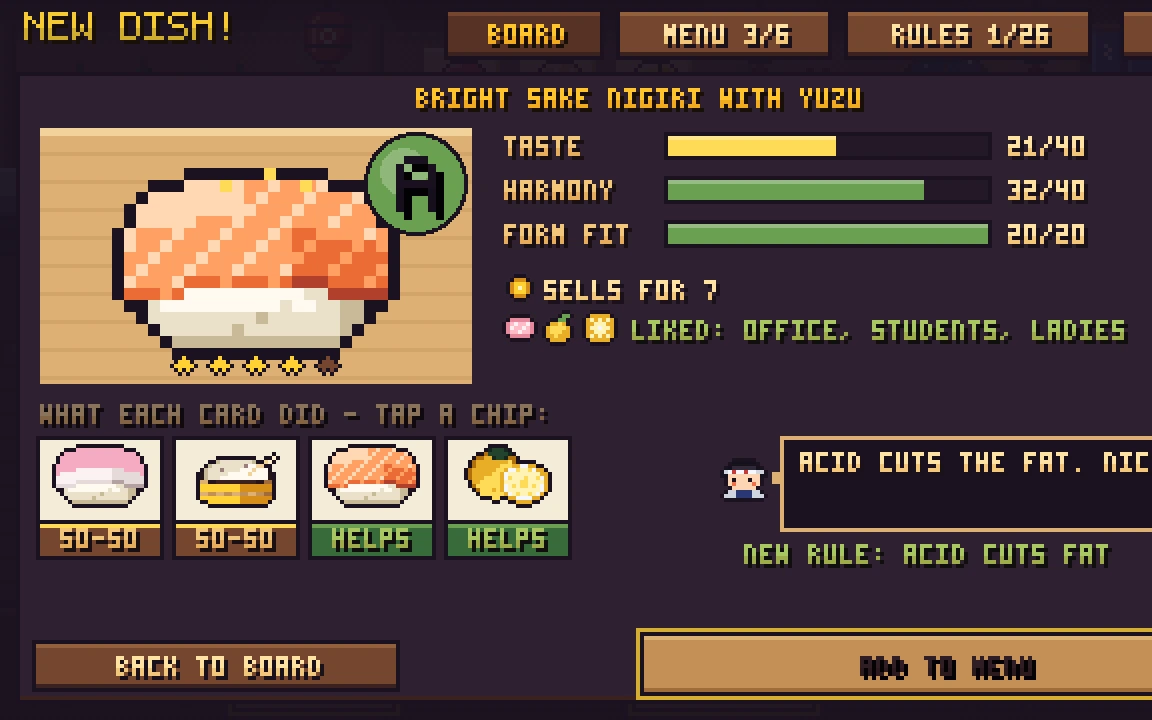
In part 2 every card was one fixed nigiri. Now the cards are ingredients. You put a form, a rice, a topping and up to two extras on a prep board, make the dish, and if you like it, it goes on the menu. Some combinations are great, and some are terrible. The goal: players should understand why.
Make a dish
Click PREP BOARD at the bottom. Try salmon with yuzu, then tamago with salt and nikiri. Open the free pack for more ingredients. Click to turn on sound. Open full screen
1. Rules, not a secret table
Combination games usually fail in one of two ways. In Doodle God the results come from a hidden list, so players can't work anything out and end up trying everything or looking it up. One reviewer still couldn't make grass after five hours (Game Wisdom). Infinite Craft has the opposite problem: a language model makes up every result, so there is nothing to learn. The games that work, like Potionomics, Atelier and Breath of the Wild's cooking, give each ingredient a few properties and score dishes by rules about those properties.
Real sushi already has the rules. Edomae chefs have spent two centuries working out what fixes what, and Sushi University writes them down (condiments, preparations). Claude turned them into 26 rules about tags, not about specific cards, so one rule works for every fish it fits:
| Rule | Effect | Where it comes from |
|---|---|---|
| Acid cuts fat | helps | kabosu and sudachi "balance the richness" of toro and mackerel |
| Flame on fat | helps | aburi (torching) is applied to fatty fish like otoro and salmon |
| Cure seasons mild fish | helps | kombu curing for flounder and sea bream |
| Herbs tame strong fish | helps | ginger and green onion on aji and mackerel |
| Drowns delicate fish | hurts | strong condiments overpower delicate fish |
| Double-seasoned | hurts | no extra soy on a piece the chef already seasoned |
| Soggy | hurts | wet toppings belong in gunkan, not on nigiri |
There are also three secret classics (shiso with squid, battera, negitoro) for players who know their sushi. A study of recipes from around the world backs the general idea: East Asian cooking tends to pair ingredients that contrast, unlike Western cooking (Ahn et al., 2011). So the rules reward contrast that solves a problem, like acid cutting fat.
2. Every try teaches something
While you build, the board shows which rules will fire, by name if you know them, or as "SOMETHING NEW…" if you don't. It never shows the grade in advance; guessing is the fun. Making a dish is free and doesn't use up cards.
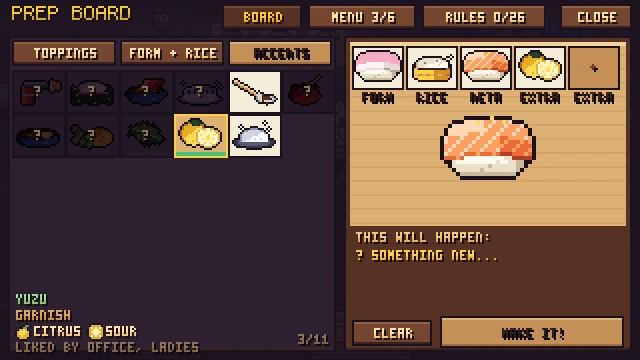
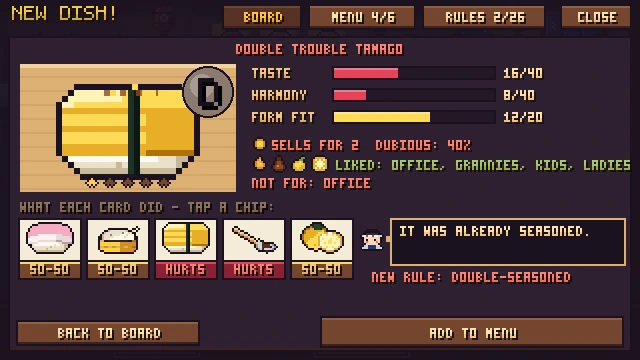
After you make a dish, every card gets a chip (helps, so-so, hurts) and the chef says one line. Chef RPG shows players the target flavour and Potion Craft shows where your potion is on its map, so a failure tells you which way you were off. Here it's the chip and the line. A bad dish still sells for 40% under a joke name, like Breath of the Wild's Dubious Food (Zelda Dungeon):
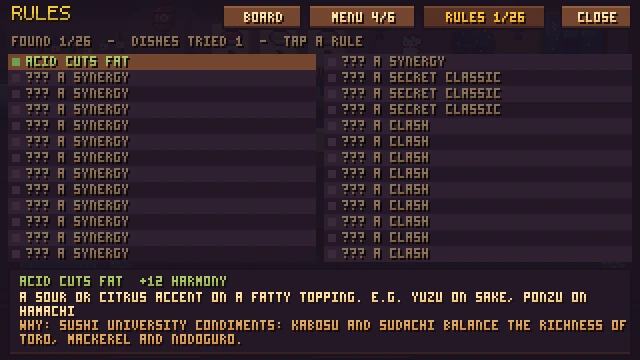
The first time a rule fires, it goes into a journal with what it means and the chef source behind it. Outer Wilds made knowledge itself the progression; here the journal is what you collect, not just the dishes:
3. Customers judge by taste
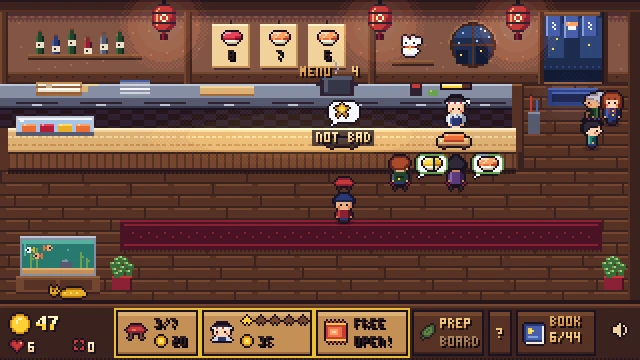
Each kind of customer likes two tags and dislikes one. Salarymen like strong, sour flavours and dislike sweet glazes, grannies like delicate and cured fish and dislike smoke, kids like sweet glazes and dislike herbs. After eating, they say what they thought with an icon and a word: SMOKY!, TOO FISHY, SOGGY!, or a polite NOT BAD. Serving the same dish too often makes it less exciting, so one perfect dish can't carry the whole menu.
4. Balanced by scoring everything
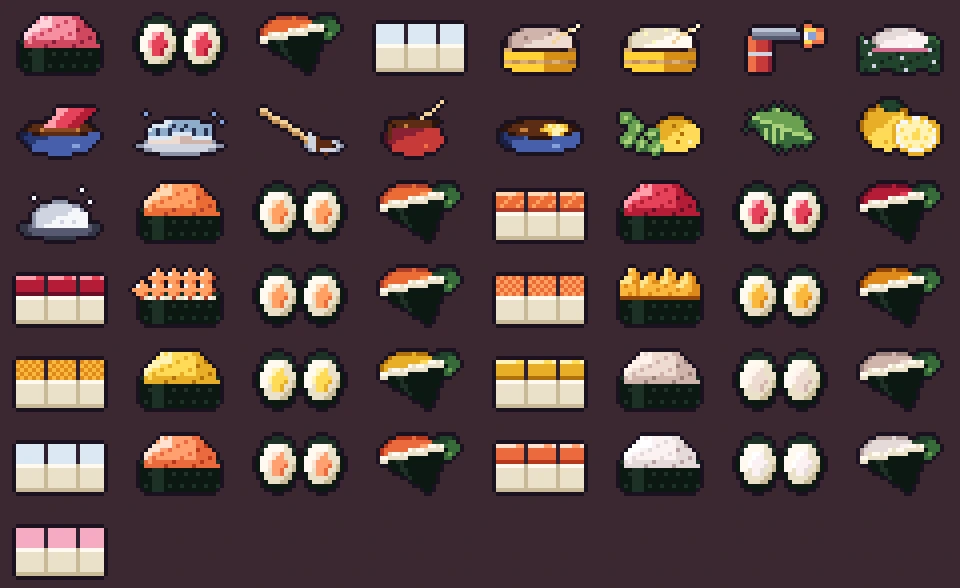
With 44 cards there are 27,135 possible dishes. Claude scored every one of them and checked the space before building any screen:
- Grades: S 3%, A 18%, B 29%, C 32%, D 18%.
- Every extra (sauce, garnish, preparation) helps some dish by at least 10 points and hurts another by at least 10. No card helps more than 60% of dishes.
- Every topping has at least two good preparations.
- The best dish is only 1% ahead of the best dish made with a different topping, so there is no single answer.
- The starting cards can show you 6 rules; after the free pack, 14.
The names are made from the recipe, like a real menu: "Bright Sake Nigiri with Yuzu", "Melting Aburi Nodoguro Oshizushi". That gives 11,652 different names. The bad ones get names like "Soggy Regret Temaki" and "Salt Mine Oshizushi".
What it cost
One prompt, no follow-ups: 30 minutes and $7.77 of Claude Code working alone, starting from the part 2 game.
What changed along the way: the old "Aburi Sake" card became the Aburi preparation card, since torching works on any fish. And invented dishes earn about 1.5 times what plain nigiri did, so packs now come too fast. That's what the next part fixes. Nothing is saved yet.
Next: the economy
Coins, upgrades and pack prices were each tuned by feel in different parts. In part 4 we balance the whole thing with bots that play the real game, so there is always something worth buying.
Add crafting to your game
- Copy the skill below into
.claude/skills/sushi-crafting/, or download it with its references. It's written for sushi, but the method works for any cooking, potion or alchemy system: give items tags, write rules about tags, and score every combination. - Ask your agent: "Let players combine ingredients into new recipes. Some should be great, some bad, and players should learn why."
- Check its report: the grade spread, that every card helps somewhere and hurts somewhere, and that no single recipe wins by a lot.
The skill that made it work
This is the skill we gave Claude Code. The full version has three reference files: the flavour model with the chef source behind every rule, how to give feedback that teaches, and how to balance the space. Copy the rules below, or download it with its references.
- Rules, not a table. Each card has a few axes (umami, fat, acid, salt, sweet, aroma, delicacy, texture) and 2–4 tags from a fixed list of about 12. Every synergy and clash refers only to tags and axes, so the player can learn it once and use it everywhere. At most about 5 hand-written special combos, as rare secrets.
- A dish is small. Form + rice + one topping + up to two accents (a preparation, a sauce or a garnish). Like Cafeteria Nipponica's base plus one or two ingredients, or Atelier's three trait slots: few slots, many cards.
- Bounded score. Quality is 0–100: Taste (40) + Harmony (40) + Form fit (20). Price multipliers (dish level, customers, shops) live outside it, in the economy. Grades read like letters (D to S) and stars.
- Clashes cost, empty slots don't. An empty accent is 0; a clash is −10 to −20. Diminishing returns: the second copy of a tag counts half, the third nothing. Fat and umami past their cap turn "heavy" unless something cuts them.
- Soft failure. A bad dish still exists, gets a funny name and sells for 30–50% of the price (Breath of the Wild's Dubious Food). Failing is cheap and always teaches something.
- Every attempt teaches a rule. After making a dish, show the three sub-grades, a green/yellow/red chip on each card (helps, neutral, hurts) and one line naming the main reason ("Acid cuts fat", "The sauce drowns the delicate fish"). Before committing, show a live preview of which rules will fire, but not the final grade. See references/feedback.md.
- A journal of rules. The first time a synergy or clash fires, add a rule card to the journal ("Acid cuts fat: kabosu, yuzu or sudachi on fatty fish"). Discovered dishes are saved to the menu with their recipe, so repeating one is one tap.
- Customers judge by tags. Each customer type likes one or two tags and dislikes one, and says so in a bubble with an icon ("too heavy", a heart for smoky). A dish counts for every tag it carries, so variety pleases more people. Serving the same dish too often makes it less exciting, so no single dish carries the whole game.
- Names that sound real. `[best-synergy word] [preparation] [topping] [form] (with [accent])`, like "Aburi Salmon Nigiri with Yuzu" or "Zuke Maguro Nigiri". Bad dishes get joke names from a table ("Soggy Regret Roll"). Names are deterministic: the same recipe always has the same name.
- Discoveries keep paying. A discovered dish can be levelled with more copies of its topping card (Dave the Diver's recipe enhancement), raising its price, so pack pulls stay useful.
- Ground it in real sushi. Each rule cites the chef practice behind it in the data file (Sushi University, Michelin, chef interviews), and the tooltip says it in plain words. Don't invent fake Japanese words.
- Measure it. Score every possible dish and report: the best 10, the share of dishes per grade, that every accent helps somewhere (+10 or more) and hurts somewhere (−10 or less), that every topping has at least two good preparations, and that no single dish beats the second best by more than about 15%. Fail the check if any card is useless or dominant. Check the bench UI in a real browser at 720 px wide and on a phone.
Save it as .claude/skills/sushi-crafting/SKILL.md in your project. Put the references folder next to it.