A second city that plays differently: Osaka's conveyor belt, and a chain built for parallel sessions
The rebuilt Neta becomes a chain: a train to Osaka, managers, earnings while away and credits. Osaka is a different place with a real twist, a conveyor belt where you choose each dish's plate colour. And every city is now a folder, so four more can be built at once. Part 8.
What we asked“Turn Neta into a chain. First build what all cities share: when Tokyo's goal is met, the next city opens with a short celebration; a map of Japan to move between cities; what carries over and what starts fresh; managers who take over chores you've done by hand; earnings while you're away; and credits after the sixth city. Then build Osaka as the second city, following CITIES.md: a different place from Tokyo with its own floor plan, local fish, guests and music, and its real twist, the conveyor belt. The other four cities will be built by separate sessions at the same time, so keep everything a city needs inside its own folder.”
What happened
- Read the rebuilt game and the guide it had left for adding cities
- Built the shared chain: the city unlock, the train ride, a map of Japan, carry-over rules, managers, earnings while away, save version 2 and the credits
- Built Osaka in its own folder: a bright belt shop by the Dotonbori canal, local hamo, corn, mayo and white kelp, local guests and its own music
- Wrote the belt as its own rules: chefs fill it, guests take what fits their wish and their budget, plates that go round three times are thrown away
- Let bots play the whole chain to balance Osaka against Tokyo
- Rewrote the city guide as a contract for the four cities that come next
In part 7 we rebuilt Neta from a one-page brief, with only Tokyo. This part turns it into a chain, and builds the second city in a way that lets the other four be built at the same time.
Play Osaka
This opens straight in Osaka as if you had come from Tokyo. Open the MENU to set each dish's plate colour. Play from the start in Tokyo (saves your game).
1. A different place, not a different colour
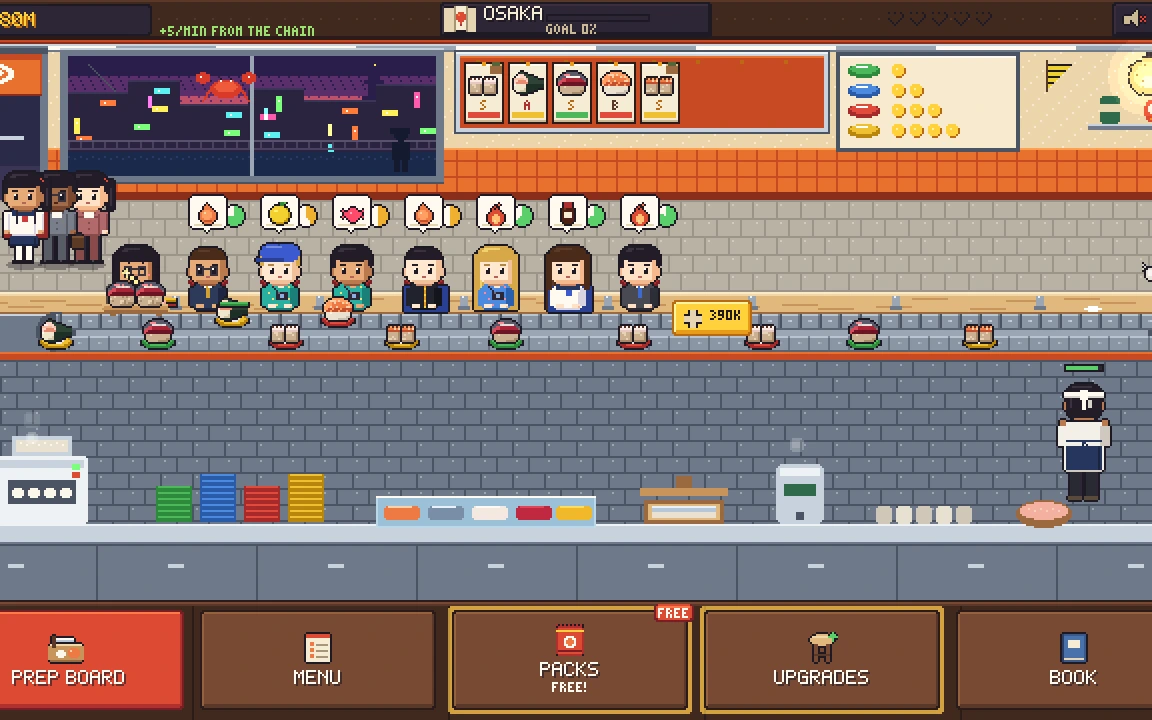
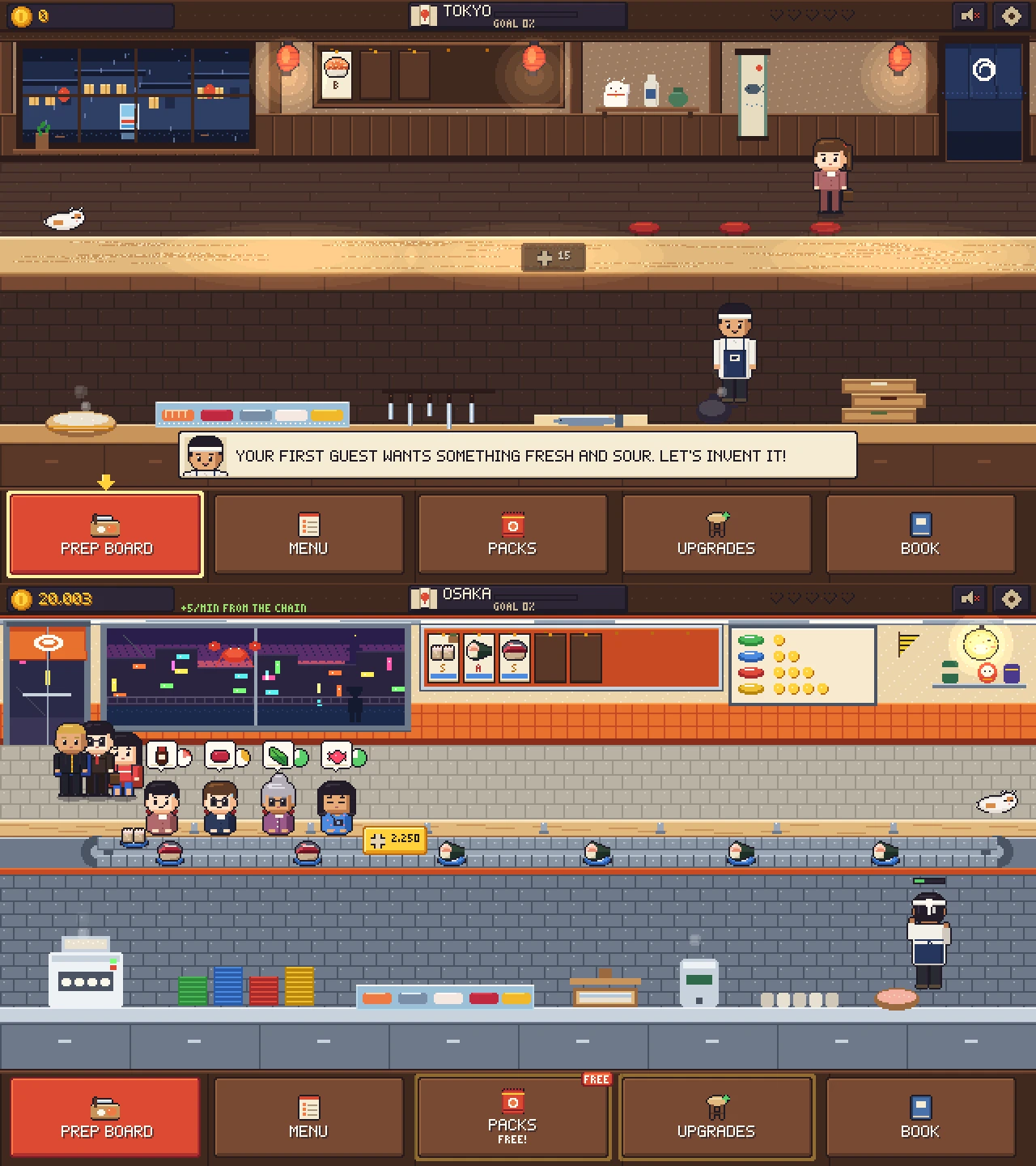
In the first version, the six cities were one room in six colour schemes. The art-polish skill asks for at least five real differences: the floor plan, landmark props, the view, the light and the local guests. Tokyo is a narrow, warm Edomae counter on a rainy night. Osaka is a bright tiled belt shop by the Dotonbori canal at dusk, with neon, a giant crab sign, a pufferfish lantern, a rice robot, towers of coloured plates and 14 seats along the belt.
2. A twist that changes how you play
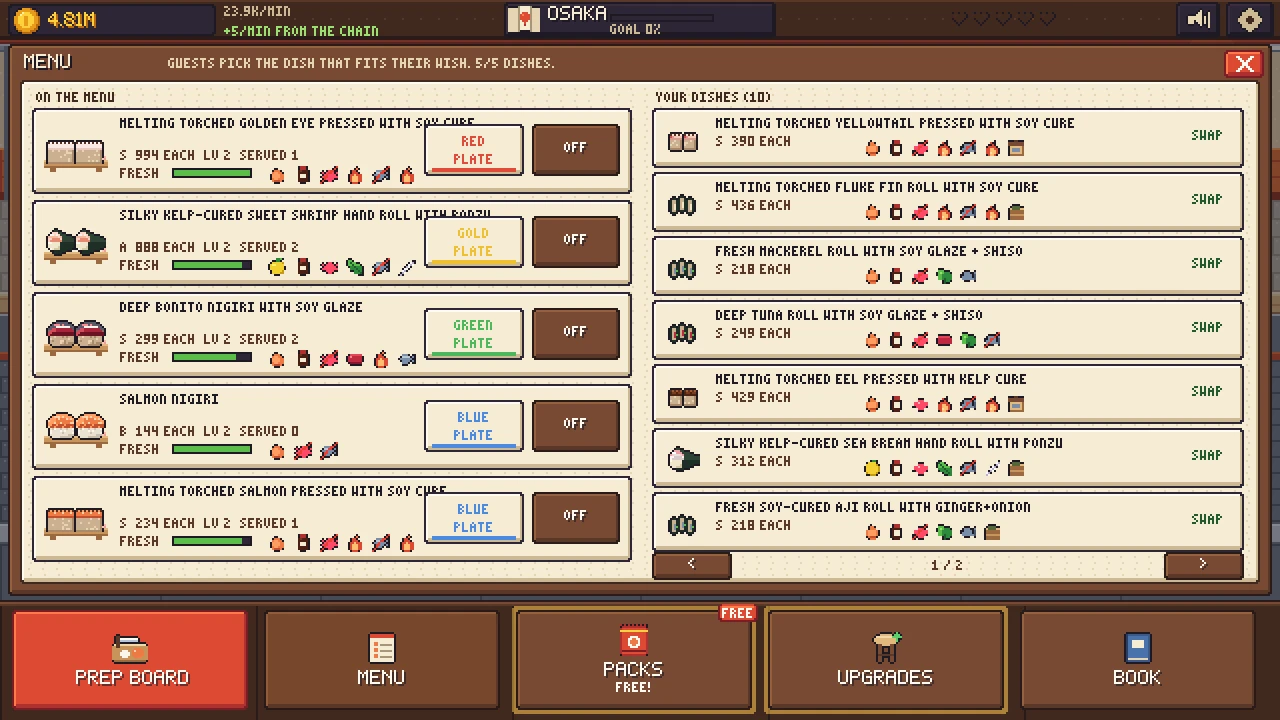
Conveyor-belt sushi was born in Osaka: Yoshiaki Shiraishi opened the first kaiten shop in Higashiosaka in 1958, and plates are priced by colour (Wikipedia). So in Osaka the chefs fill the belt without orders, guests take plates that fit their wish and their budget, eat two to four, and pay for the stack. Plates that go round three times are thrown away.
That gives Osaka a decision Tokyo doesn't have: the plate colour of each dish, from green (×0.7) to gold (×2). Kids and students won't take red or gold; tourists and merchants will. The menu shows what share of guests would take each dish, and guests call out "TOO DEAR!" when they let one pass.
3. What every city shares
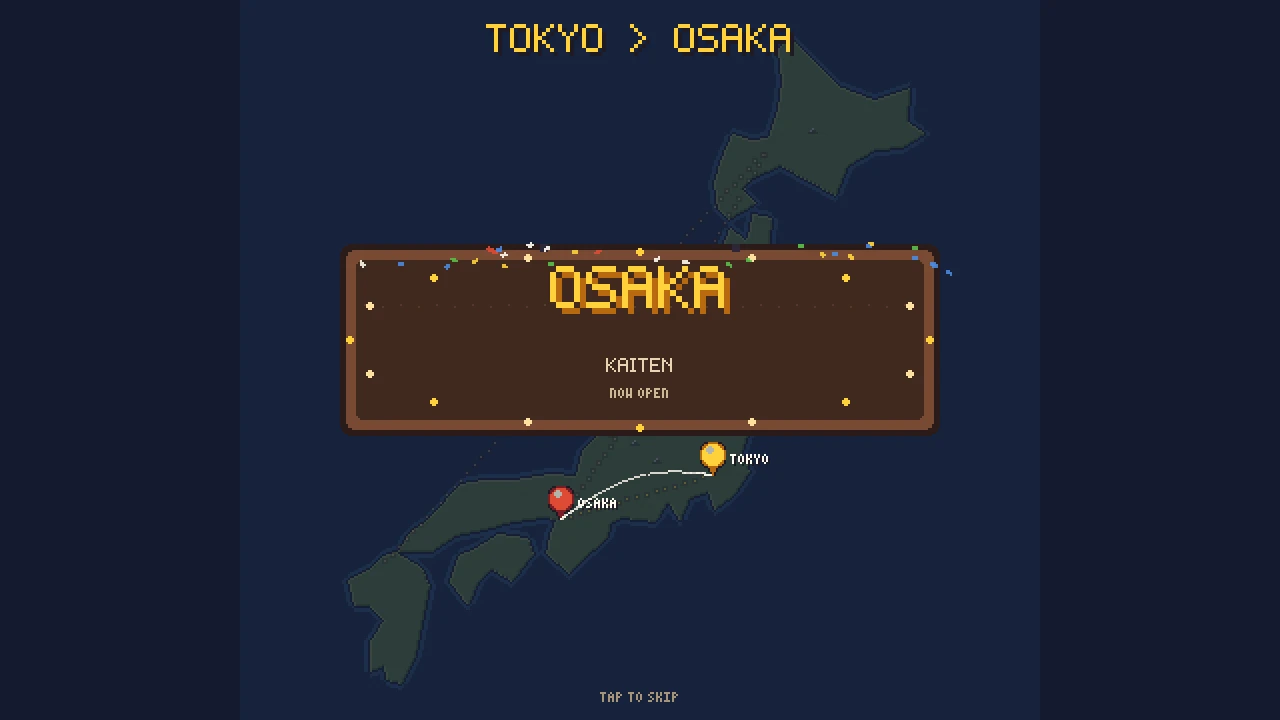
- Opening the next city. When Tokyo meets its goal, a card offers to go. A train crosses a pixel map of Japan, then the new sign drops and its bulbs light up.
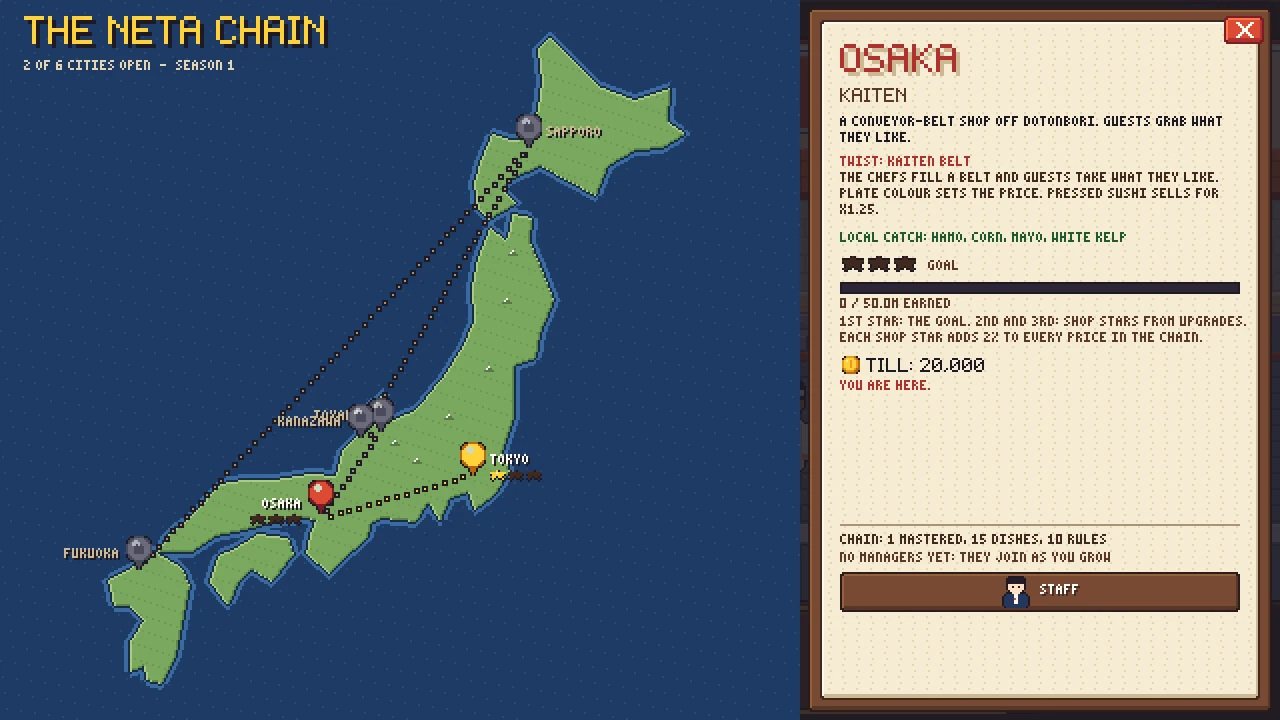
- A map of Japan with a pin and up to three stars per city, and the twist, local fish and goal of each.
- What carries over: cards, the recipe book, every dish you invented and your managers. Seats and upgrades start again, with a fast start and a free pack of local fish.
- Finished shops keep running and send 10% of their income to the shop you're in.
- Managers (a host, a buyer and a steward) join once you've done their chore by hand enough times.
- Earnings while away: half the normal rate for up to four hours, on a welcome-back card.
- Credits after the sixth city, then a new season with prices up 10%.
4. Built for parallel sessions
Every city is one folder, found automatically. A city declares everything about itself in one place: its floor plan, local cards and guests, flavour classics, its twist, its music, its numbers and even a different way of serving (Osaka's belt is one). The session rewrote the city guide as a contract for the next cities and added a command that balances one city inside the whole chain.
That is why the other four cities, Toyama, Kanazawa, Sapporo and Fukuoka, are being built right now by four separate Claude Code sessions at the same time, each touching only its own folder.
Balance
Bots play the whole chain. Tokyo takes a median of 37 minutes to its goal, Osaka 38, about 76 minutes for both. The bots mix gold and red plates instead of always choosing one.
What it cost
One prompt, no follow-ups: 79 minutes and $20.04 of Claude Code working alone.
Weak spots it reported: Osaka's length depends a lot on what you bring from Tokyo (one weak bot run took 83 minutes), and the bot that always buys the cheapest thing waits up to 84 seconds with nothing to buy in Osaka, over the 60-second limit. The credits can only be tested through a debug link until the sixth city exists.
Next: four cities at once
Next we put the four cities built in parallel into one game and play the whole chain to the credits.
Grow your own game
- Copy the skill below into
.claude/skills/restaurant-chain/, or download it with its references. - Ask for the shared systems and one new location first, and ask for each location to live in its own folder.
- Then start one session per location at the same time, each told to touch only its folder.
The skill that made it work
This is the skill the session leaned on most. The full version has two reference files: Japan's regional sushi styles with sources, and saves and offline earnings. Copy the rules below, or download it with its references.
- A short campaign of shops. About 5–7 shops, each 20–35 minutes of play, ending in credits after 2–4 hours. Each shop has a clear goal shown on screen (stars, like Two Point Hospital: 1 star opens the next shop, 2–3 stars are optional and give a small bonus for the whole chain). The player can go back to any shop.
- Each shop is a different place. Its own look (palette, room layout, props), 3–5 local ingredients, one signature style and one twist mechanic, all from real regional sushi (see references/locations.md): Tokyo Edomae (cured fish), Osaka (pressed box sushi, and the conveyor belt was born there), Toyama (masu-zushi), Kanazawa (Sea of Japan fish, a market), Hokkaido (crab, uni, ikura, seasons), Fukuoka (goma-saba). A twist changes how you play, not just the numbers.
- What carries over, what resets. Keep cards, discovered recipes and the collection. Reset seats, staff and shop upgrades. A new shop starts with a short fast start (about the income the previous shop had after 5 minutes) so it never feels like starting from zero.
- Finished shops keep working. A shop that reached its goal runs automatically and adds its income (or a share, 5–10% of the chain's) while the player is elsewhere. Show it on a chain map.
- Managers take over chores. Hiring a manager (a chef, a host, a buyer) removes a repeated click: auto-serve, auto-restock, auto-open the cheapest pack. Unlock each one after the player has done that task by hand for a while, and put it next to a milestone so it feels like a reward.
- Opening a shop is a moment. A 3–5 second celebration: the chain map, the train or walk to the new city, the new shop's sign going up and lights coming on.
- Offline earnings. On return, a welcome-back card: time away, coins earned, what managers did, and one suggested next step. 50% of the online rate, capped at about 4 hours. No ad to double it. Ignore clocks that went backwards; never earn for shops that aren't open.
- Saves that don't lose progress. One versioned JSON save with a migration chain. Autosave every 30 s, when the tab is hidden and before unload. Two rotating backups, export and import as a text string, and ask the browser for persistent storage. Warn in settings that Safari can wipe site data after 7 days without a visit; the export string is the fix.
- A real ending. Reaching the last shop's goal plays credits and a chain summary (shops, sushi invented, plates served, time played). After the credits the player can keep playing, and optionally start a "new season" with a small bonus.
- Measure it. Extend the economy bots to play the whole campaign: time to each shop's first star (no shop more than about 1.5× its neighbours), total time to the credits, longest gap with nothing to do, and that the fast start works. Test save, reload, export/import and offline earnings with a faked clock. Check the chain map and each shop in a real browser at 720 px wide and on a phone.
Save it as .claude/skills/restaurant-chain/SKILL.md in your project. Put the references folder next to it.