Fewer choices, better choices: 3-card packs and a pick of three for every new card
A second playtest of Neta found too much on screen: 8-card packs, a workbench full of ingredients, black silhouettes of locked cards. Two Claude Code sessions cut it down: 3-card packs, one try per new card as a pick of three readable trade-offs, and only what you own on screen. Part 12.
What we asked“A second playtest, in the player's words: there are so many things on the prep board, which is kind of bad. There are too many cards in a pack. Don't show unavailable ingredients as black. Need to reduce the choice options. The player should try a new recipe once, only when he gets an ingredient. DESIGN.md is updated: 3-card packs, each new card brings one try as a pick of three, no workbench, and nothing on screen the player doesn't own.”
What happened
- Cut packs to 3 cards and rescaled odds and pity
- Replaced the prep board and the pool of ideas with a pick of three after each new card
- Turned the menu into the three dishes plus a recipe book, and removed every locked card and empty slot
- Re-ran the bots and slowed pack prices so the route still takes about 3¾ hours
- A second, shorter prompt fixed what review of the screenshots found: offers that barely differed, a leftover card over the bottom bar, cut-off dish names and the staff screen's silhouettes
After part 11 we played Neta again. The numbers worked, but the screen didn't:
"There are so many things on the prep board, which is kind of bad. There are too many cards in a pack. Don't show unavailable ingredients as black. Need to reduce the choice options."
Part of that was our own design. We had made "one try per card" a pool of up to 8 saved ideas, spent at a workbench that showed every ingredient you own, plus black slots for the ones you don't. This part ties each try to its card and cuts the screen down to three choices.
Play it
Your first pick comes in the first seconds. Open full screen (saves your game).
What changed
| Before | Now |
|---|---|
| 8-card packs | 3 cards: a level-up for your best fish, one new card, one Rare or better |
| A pool of up to 8 ideas, spent any time | Each new card brings one try, right after its reveal |
| A workbench with every ingredient you own | A pick of three recipes that use the new card |
| Black silhouettes, empty slots, locked rows | Only what you own |
1. A pick of three
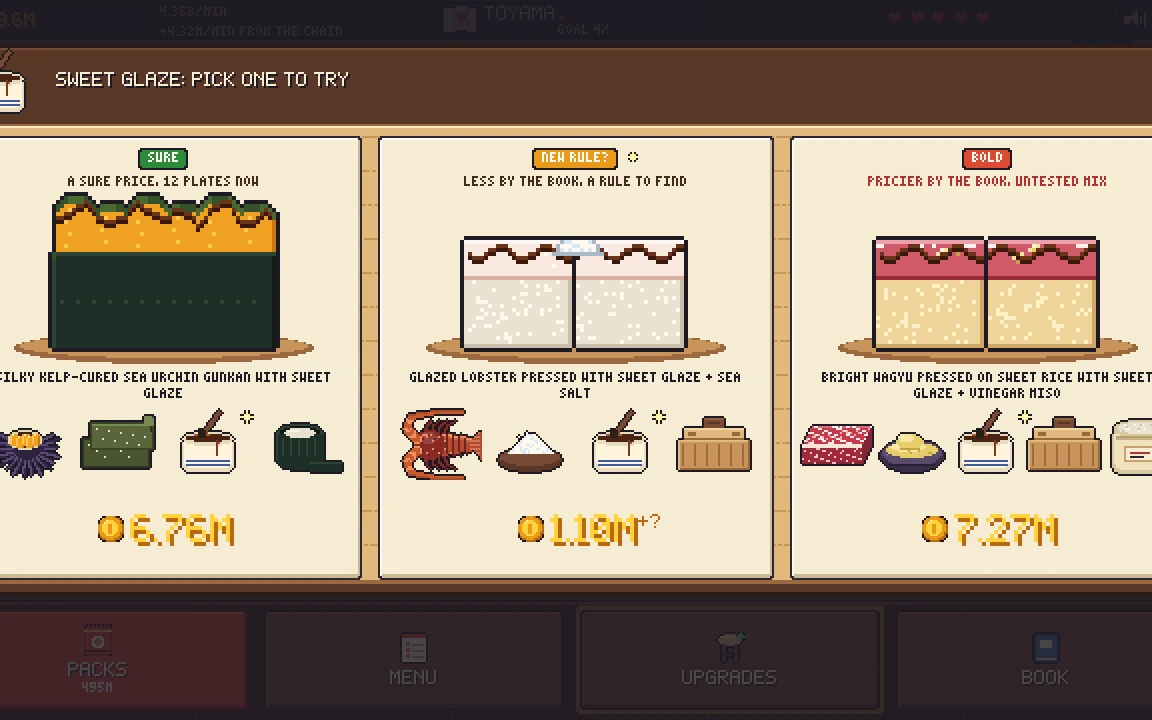
Pick-one-of-three is the pattern that keeps a card reward fast to read: Slay the Spire offers three cards after a fight, and you can always see the difference. Here, the moment a new card is revealed, you get three recipes that use it, built from what you already own, each with its price predicted from the flavour rules you've found:
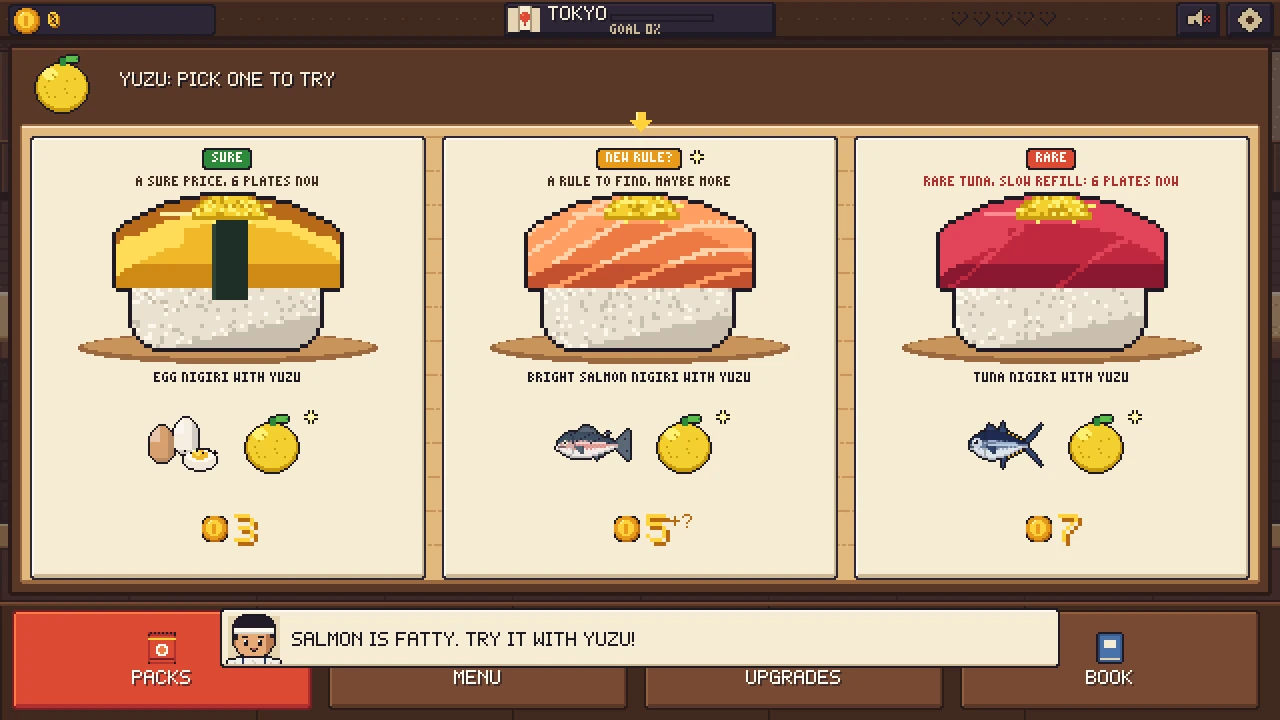
The salmon says 5, but it fires "acid cuts fat", a rule you haven't found yet, and sells for 9. Each option is a different trade-off, said in one line at the top:
- Sure: every rule it uses is in your book. A sure price, and plates now.
- New rule?: less by the book, but it may fire a rule you haven't found.
- Rare or bold: pricier, but it eats a rare fish's slow stock, or it's an untested mix that may clash.
- Sell it: when there's nothing left to find, take coins now instead.
The three always differ in form or rice, not just one accent, and the accents show on the sushi, so you can tell the plates apart before you read a number:
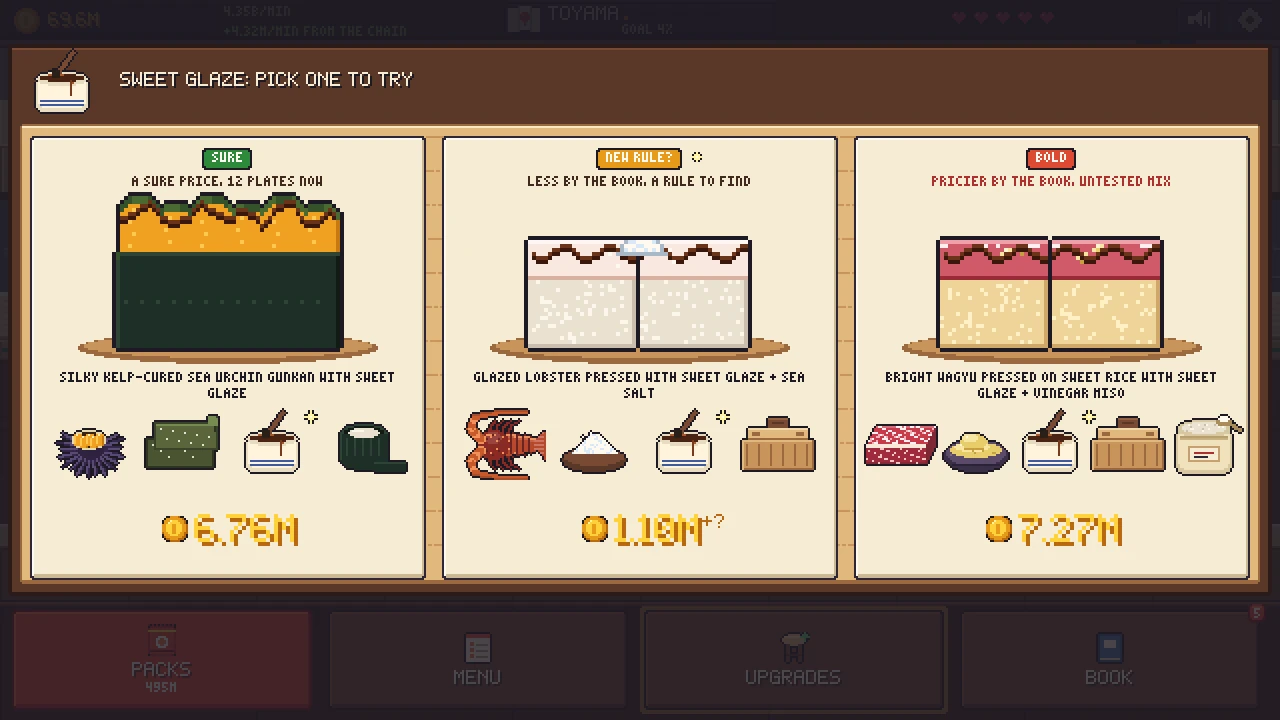
The first version of this screen offered three yellowtail nigiri at 18, 16 and 16 that looked the same. A second, shorter prompt fixed that, and added a check that runs on every build: no two options of the same kind, and different form or rice in 80% of picks where you own more than one.
2. Packs of three
Three cards is enough when each one matters: one levels up the fish of your best dish, one is new, and one is Rare or better. The ending still counts up what the pack did:
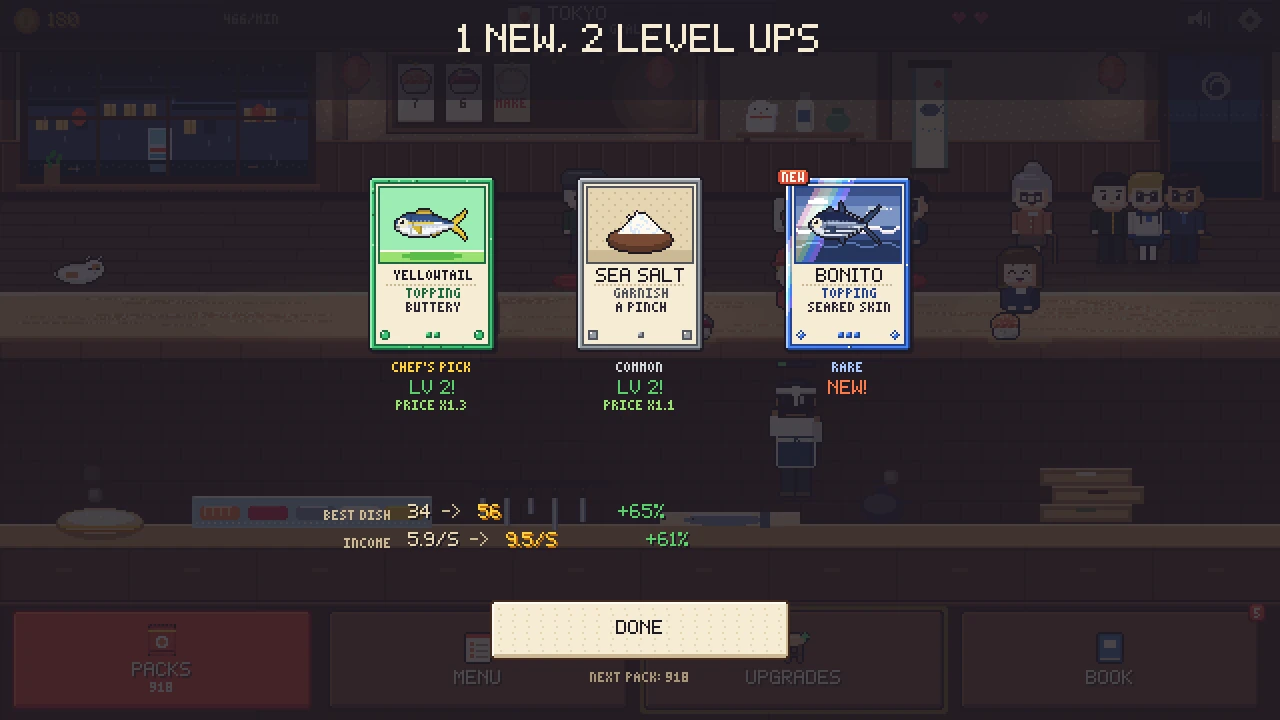
3. Only what you own
The workbench is gone. The menu screen holds the dishes on your menu, with their stock and a button to make a new batch, and a recipe book of everything you've invented, most expensive first. Names now fit the row: the game picks shorter whole words (sweet rice becomes amazu) instead of cutting mid-word, and a check confirms all 184,230 possible dishes fit at 720 px with no two sharing a name.
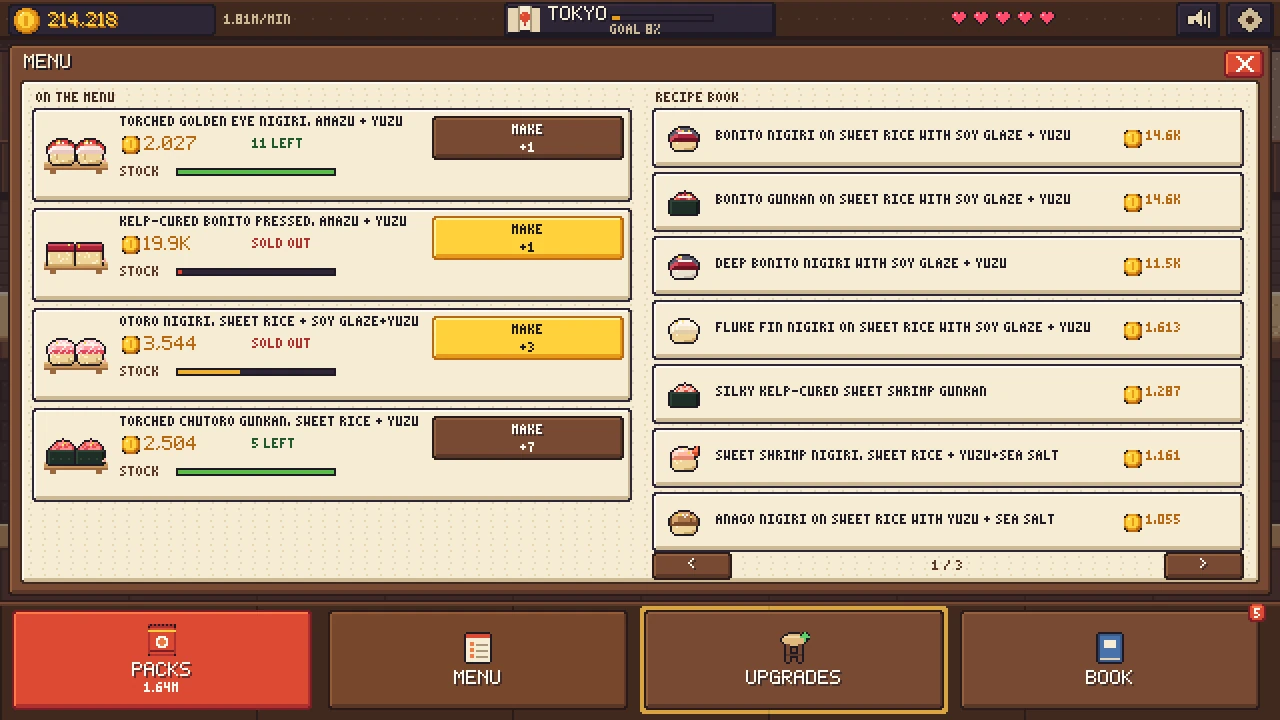
The book shows only rules you've found, upgrade rows appear when you can use them, and the staff screen shows the managers you've hired plus one line on who joins next.
Balance
Smaller packs made every city slower at first (the route went from 3:51 to 5:24), so pack prices now grow more slowly, and four cities have their own pack price factor. The bots pick from the same three offers as you.
| City | Tokyo | Osaka | Toyama | Kanazawa | Sapporo | Fukuoka | Route |
|---|---|---|---|---|---|---|---|
| Median minutes | 38 | 45 | 37 | 29 | 34 | 32 | 3:46 |
What it cost
Two prompts: 77 minutes and $13.16 for the change, then 70 minutes and $13.60 for the fixes, $26.76 in total.
Still weak: three cards make luck count more (Osaka takes 31 to 66 minutes depending on the run); packs in later cities raise income only 3–7%, so their ending feels small; and late in a city, "sell it" can be worth far more than either dish, which makes the choice too easy.
Next: doing the math
A third playtest got stuck in Osaka, so the next part rebuilds the upgrades and packs from a formula.
Cut your choices down
- Copy the skill below into
.claude/skills/sushi-crafting/, or download it. - Give each reward one decision of three, and make the three differ in a way you can see before you read.
- Remove everything the player can't use yet: locked silhouettes, empty slots, rows they can't buy.
The skill that made it work
The crafting skill, updated again: a try comes with a card, as a pick of three different trade-offs, and only what the player owns is ever on screen. Copy the rules below, or download it with its references.
- Rules, not a table. Each card has a few axes (umami, fat, acid, salt, sweet, aroma, delicacy, texture) and 2–4 tags from a fixed list of about 12. Every synergy and clash refers only to tags and axes, so the player can learn it once and use it everywhere. At most about 5 hand-written special combos, as rare secrets.
- A dish is small. Form + rice + one topping + up to two accents (a preparation, a sauce or a garnish). Like Cafeteria Nipponica's base plus one or two ingredients, or Atelier's three trait slots: few slots, many cards.
- Bounded score. Quality is 0–100: Taste (40) + Harmony (40) + Form fit (20). Price multipliers (dish level, customers, shops) live outside it, in the economy. Grades read like letters (D to S) and stars.
- Clashes cost, empty slots don't. An empty accent is 0; a clash is −10 to −20. Diminishing returns: the second copy of a tag counts half, the third nothing. Fat and umami past their cap turn "heavy" unless something cuts them.
- Ingredients are stock, not unlocks. Each owned card gives a stock of portions that refills over time (its level raises both the cap and the refill rate). Making a batch of a dish uses one portion of each ingredient per plate; the dish sells until its batch runs out. Refill speed, stock size and batch size are upgrade lines. Infinite free ingredients make the choice meaningless (Minecraft can do it; an incremental can't): variety must come from the numbers, so when the best ingredient runs dry, the second-best dish earns while it refills. A bad dish wastes stock and sells for 30–50% of the price (Breath of the Wild's Dubious Food).
- Every attempt teaches a rule. After making a dish, show the three sub-grades, a green/yellow/red chip on each card (helps, neutral, hurts) and one line naming the main reason ("Acid cuts fat", "The sauce drowns the delicate fish"). A try comes with a card: a new ingredient brings one try, offered as a pick of three recipes that use it, built from what the player owns. Each is a different trade-off the player can read in one line (a sure price now; maybe a new rule; a dearer dish that eats a rare fish's stock), they differ in form or rice and not only in accents, and the plates look different at a glance. Never two of the same kind; when there is nothing left to find, offer something else worth choosing (sell the card for coins now). No free workbench and no saved pool of tries: an incremental player wants a good choice, not a crafting table with 40 cards on it. On each of the three, show the price predicted from the rules the player already knows; undiscovered rules that fire are a surprise bonus on top, so no try is blind. See [references/feedback.md](references/feedback.md).
- Few choices on screen. Show only what the player owns and can use now: no black silhouettes of locked cards, no empty slots for things not yet earned. Three options beat thirty.
- A journal of rules. The first time a synergy or clash fires, add a rule card to the journal ("Acid cuts fat: kabosu, yuzu or sudachi on fatty fish"). Discovered dishes are saved to the menu with their recipe, so repeating one is one tap.
- In an incremental, the player cares about the number. No customer preferences or wishes to satisfy: customers are the crowd that eats and pays, and their reactions scale with the price (a gasp and a big coin for an expensive plate). The goal of inventing is a dish as expensive as possible. Show the price building up like a Balatro hand: base, then each multiplier (ingredient level, each rule that fires, the city bonus) counted up one at a time with a rising pitch, bigger effects for bigger results.
- Names that sound real. `[best-synergy word] [preparation] [topping] [form] (with [accent])`, like "Aburi Salmon Nigiri with Yuzu" or "Zuke Maguro Nigiri". Bad dishes get joke names from a table ("Soggy Regret Roll"). Names are deterministic: the same recipe always has the same name.
- Duplicates level the ingredient. A second copy of a card raises that ingredient's level (Clash Royale, Marvel Snap): more value per plate, more stock, faster refill. Every dish using it gets more expensive at once, so every pack pull raises a number.
- Ground it in real sushi. Each rule cites the chef practice behind it in the data file (Sushi University, Michelin, chef interviews), and the tooltip says it in plain words. Don't invent fake Japanese words.
- Measure it. Score every possible dish and report: the best 10, the share of dishes per grade, that every accent helps somewhere (+10 or more) and hurts somewhere (−10 or less), that every topping has at least two good preparations, and that no single dish beats the second best by more than about 15%. Fail the check if any card is useless or dominant. Check the bench UI in a real browser at 720 px wide and on a phone.
Save it as .claude/skills/sushi-crafting/SKILL.md in your project.