Why your game gets boring after ten minutes: new things on a schedule, rest beats and three more pacing tricks
Five pacing tricks that keep a game fresh, shown side by side: new elements on a schedule, four steps per mechanic, rest beats, a midpoint twist and cutting padding. With a copyable Claude Code skill.
What we asked“Make a web page that demonstrates the pacing tricks that keep a game from getting boring one at a time, so anyone can see and feel each one within a few seconds. For each one, show the same short moment side by side: without it on the left, with it on the right, playing in a loop, with a caption that says what just happened and a replay button. Where it helps, let me play the moment myself. It will sit inside a blog post about 720 pixels wide, so it has to look good at that width and on a phone. Also make each one viewable alone with ?trick=<id>&solo, using these ids: new-on-schedule, four-steps, rest-beats, midpoint-twist, cut-padding. Show each moment as a short session sped up (a few seconds standing in for several minutes of play), with a live intensity graph under each side that marks when something new appears. Use the internet freely for better results: free CC0 art, fonts or small libraries (for example Kenney's CC0 assets) are welcome; download anything you use into this folder so the page works without outside links, and list each item with its licence and source in CREDITS.md.”
What happened
- Loaded the pacing-plan skill
- Downloaded Kenney's free shmup, dungeon and font packs
- Wrote a shared engine with a live intensity graph, then a shooter for four tricks and a small dungeon for the fifth
- Fixed the phone layout and checked it at a 390 px phone width
- Tested play mode with keys, pointer and taps, including the shop cards
- Made starting play in one demo stop play in any other, then checked the shop, the end card and light mode
The first ten minutes of your game are fun. Then the player has seen everything, the waves just get bigger, and somewhere around minute twenty they put it down. That’s a pacing problem, and it’s rarely fixed by adding more content. It’s about when things appear, and what happens between the big moments.
Each demo below plays a short session sped up: 18 seconds stand in for 6 to 30 minutes of play, with a game clock in the corner. Both sides run the same game with the same random seed and the same bot; the only difference is one switch. Under each side, a live intensity graph is measured from what’s on screen (threats and bullets near the player, plus hits), and a ◆ marks each time something new appears. Press Play “without” or Play “with” to take over from the bot: steer with the mouse, a finger or the arrow keys, and firing is automatic.
1. New things on a schedule
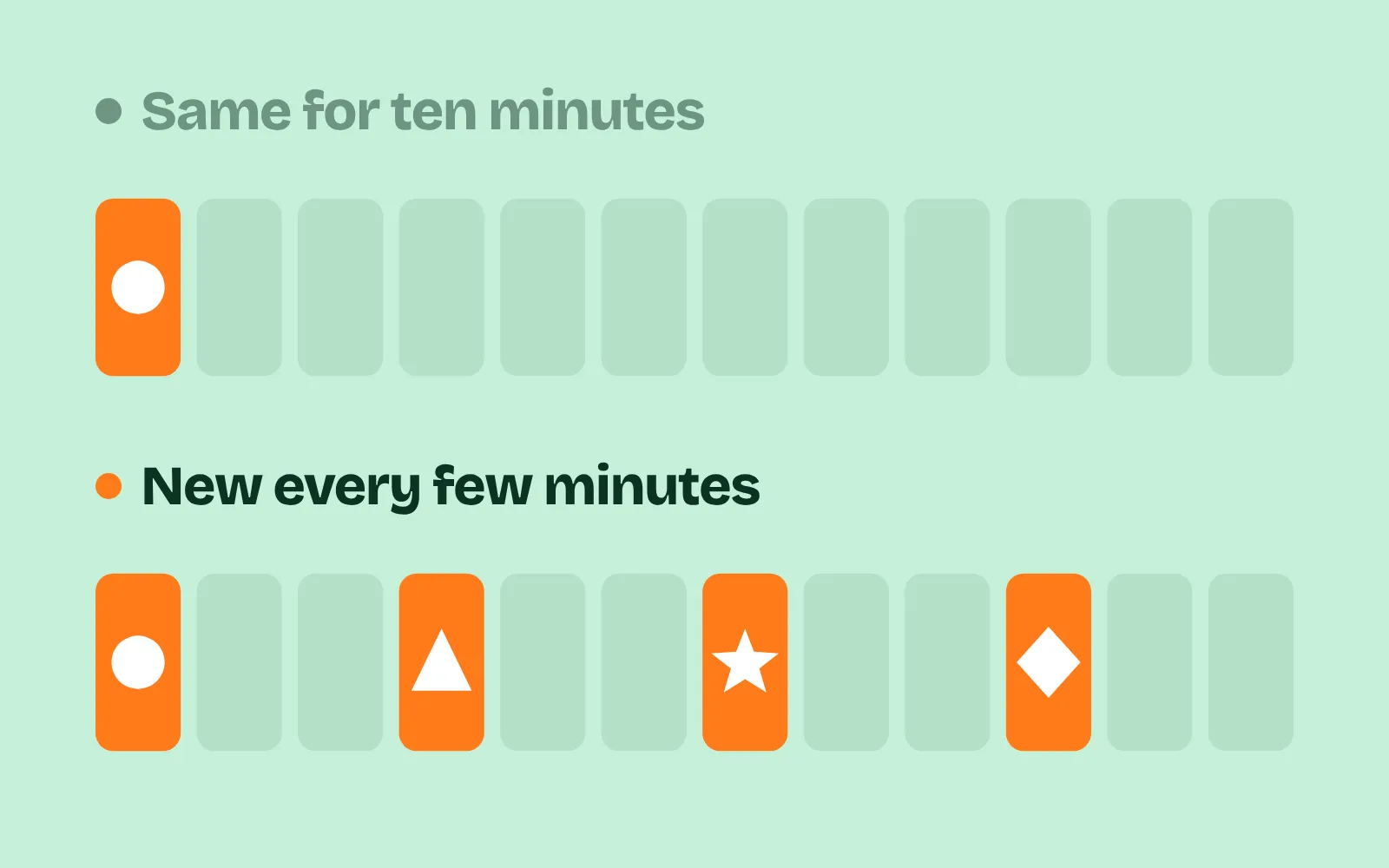
Spread new enemies, weapons and rules over the whole game instead of handing them all out at the start. Plants vs. Zombies gives the player a new plant at the end of nearly every level of its Adventure mode (Wikipedia). Its creator George Fan told GDC to “spread out the teaching of game mechanics”: PopCap held money back until after 10 levels and saved the Zen Garden for near the end (Game Developer). A rule of thumb: something new every 2 to 5 minutes early on, every 5 to 10 later. On the left, all seven unlocks land in the first two minutes. On the right, the same seven arrive one every 2 to 3½ minutes. In our demo, the longest stretch with nothing new drops from 18:11 to 3:30.
2. Four steps per mechanic
Don’t just add a mechanic; walk it through four beats. Introduce it where it’s safe, develop it in a harder spot, twist it so it’s used in an unexpected way, then give a final test. Super Mario 3D Land director Koichi Hayashida describes his levels as four-panel comics: “you introduce a concept”, “develop the idea a little bit more”, then “something of a change-up”, then “your conclusion” (Game Developer). On the left, mines are thrown into a full fight and used the same way all level. On the right, a lone mine comes first, then mines inside packs, then an armoured bomber that drops mines on you, which you blow up under it. Ways the mine gets used in our demo: 1 on the left, 4 on the right.
3. Rest beats after peaks
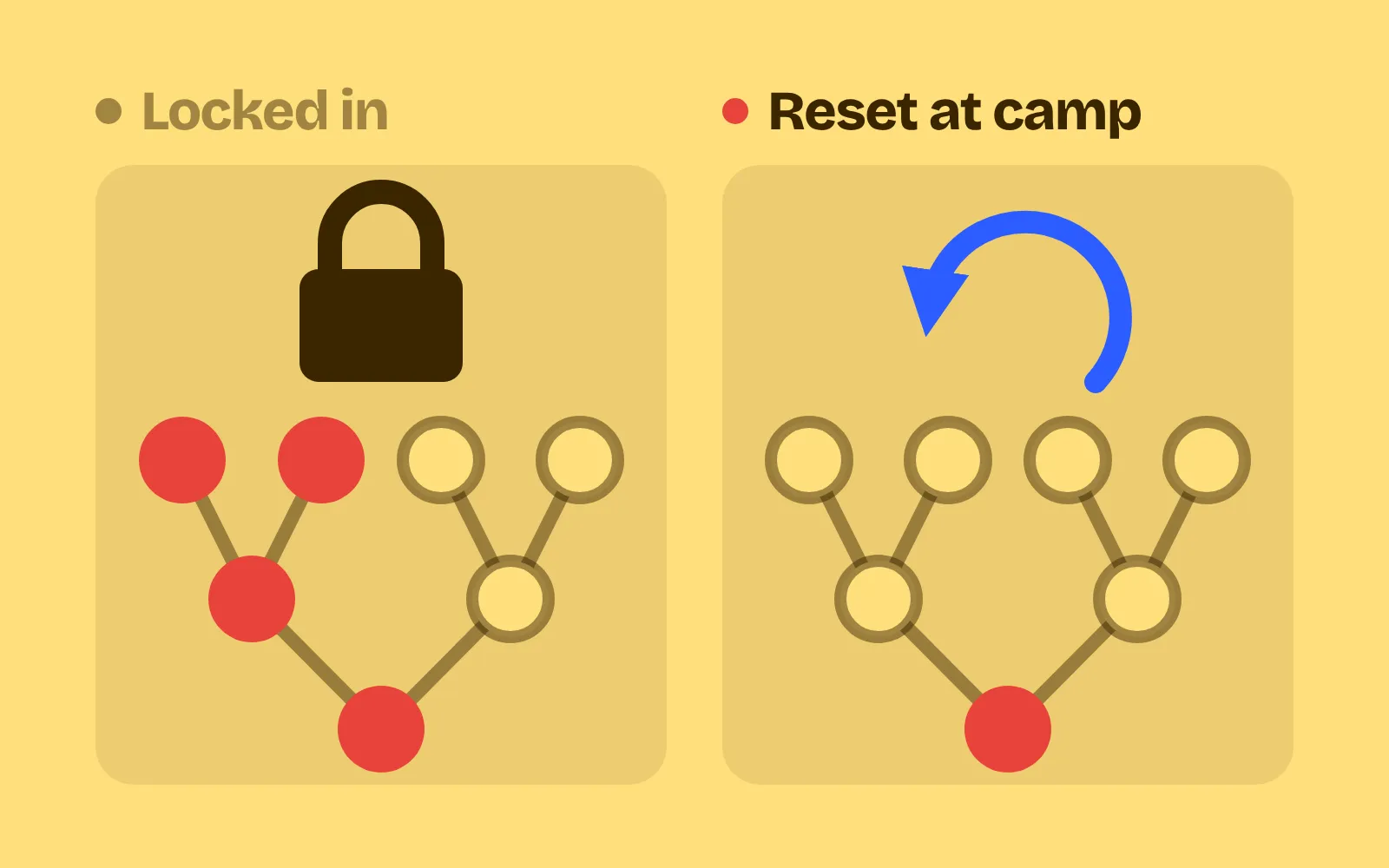
Constant pressure isn’t exciting; it’s flat. After each peak, drop to a calm stretch, and give the player a light decision in it so it isn’t an empty wait. Valve’s Left 4 Dead director keeps threats minimal for 30 to 45 seconds after a peak, and Valve’s slides put it simply: “constant, unchanging combat is fatiguing” (Valve, GDC 2009). Resident Evil 2 remake director Kazunori Kadoi called its save rooms “a safe place to take a breather” (PC Gamer). On the right, each wave builds, peaks, then a calm stretch opens a 3-card shop (tap a card or press 1 to 3). In our demo, time above 60% intensity drops from 87% to 21%, and each peak climbs higher than the last.
4. A rule change at the midpoint
The middle of a game drags when the last half plays exactly like the first. Hold back one change to how the game plays and spring it halfway through: take away a free resource, add a movement ability, turn the map around. Plants vs. Zombies does this stage by stage: at night “sun is not generated naturally”, so players lean on cheaper mushrooms, and later stages add a pool, fog and a roof (Wikipedia). On the left, coins fall from the sky for all 30 minutes. On the right, night falls at 15:00: no more free coins, kills drop them instead, and the map turns 180°. Watch the graph dip and climb again as the player relearns the game with the same controls.
5. Cut the padding
Padding is time with no decisions in it: long walks back, fetching the same thing again, grinding the same enemies. Open a shortcut home after each loop, and put something new in any area the player must cross again. In Dark Souls, according to a Game Developer community blog, “Sen’s fortress has a huge shortcut that literally drops you back at the start of the level”, while the same author criticises areas where missing shortcuts meant “running to and from bonfires” (Game Developer). This demo is a small dungeon. On the left, the hero grabs the chest and walks the whole cleared U back to camp past the same respawned enemies. On the right, a door opens beside the chest, and each loop puts ghosts and a potion in the old halls. The hatched parts of the graph are time spent crossing cleared ground: 3:19 on the left, 1:39 on the right in our demo, and loot banked goes from 1 to 2.
Don’t flatten it the other way
Pacing is a rhythm, not “more new stuff, faster”. A few rules the skill follows:
- New things every 2 to 5 minutes early, every 5 to 10 later. Faster than that, players never learn what they already have.
- Calm stretches stay short and hold a choice. A shop, a build or a plan, never an empty corridor. In the skill, calm stretches with no choice should be 0.
- Measure it, don’t guess. Log when each new thing first appears and when the peaks are. In the first half hour, the longest gap with nothing new should be under 5 minutes.
If your game gets harder too fast rather than too samey, that’s a different problem: see difficulty curves. For how a game’s first minute is paced, see video game openings.
Add it to your game
- Copy the skill at the end of this page into your project.
- Ask your agent: “My game gets boring after ten minutes. Fix the pacing.”
- Play it, then tune in plain words: “The calm after wave 3 is too long, I’m just waiting.”
Art in the demos: Pixel Shmup, Tiny Dungeon and Kenney Fonts by Kenney (CC0).
The skill that made it work
This is the whole skill we gave Claude Code. Copy it into your project and ask your agent to fix your game's pacing. Every trick sits behind its own switch, and the last step logs when new things appear so you can see the gaps.
- Lay the game out as a timeline: each level, wave or day, its length, what first appears in it, and where the intense and calm parts are.
- Put every trick behind one named switch in a single settings object, all on by default, so each can be tested on its own.
- new-on-schedule. Add something new every 2 to 5 minutes of play early on, every 5 to 10 later. Spread unlocks over the whole game. Plants vs. Zombies holds money back until after 10 levels and saves the Zen Garden for near the end.
- four-steps. Give each mechanic four beats: introduce it safely, develop it in a harder spot, twist it so it's used in an unexpected way, then a final test. Super Mario 3D Land's levels follow this four-panel-comic shape, director Koichi Hayashida says.
- rest-beats. After each peak, drop to a calm stretch with light decisions (shop, build, plan the next wave), never an empty wait. Left 4 Dead's director keeps threats minimal for 30 to 45 s after a peak; Valve's slides say "constant, unchanging combat is fatiguing".
- midpoint-twist. Hold back one element that changes how the game plays for the middle: no free resources, a new movement ability, the map turned around. Plants vs. Zombies changes a rule each stage: night has no falling sun, then come a pool, fog, a roof.
- cut-padding. Cut time with no decisions in it: long walks back, repeat fetches, grind. Open a shortcut back to the start after each loop, and put something new in any area the player must cross again. Dark Souls' Sen's Fortress has a shortcut that drops you back at the level's start.
- Measure it. Log a timestamp for every first appearance and every peak in a playthrough or bot run. Report the longest gap with nothing new (under 5 min in the first half hour), calm stretches with no choice in them (should be 0) and minutes spent crossing cleared space (should drop).
Save it as .claude/skills/pacing-plan/SKILL.md in your project. Or connect your agent and type /aigamedev: it loads this skill with its reference files and the results from this post.