Why players quit before the fun starts: cold opens, a first win in 60 seconds and three more video game opening tricks
Five tricks for a game's first minute, shown side by side: an instant start, a cold open in the core loop, a fast first win, story after the win and setup left to defaults. With a Claude Code skill.
What we asked“Make a web page that demonstrates the tricks that get players to the fun in the first minute one at a time, so anyone can see and feel each one within a few seconds. For each one, show the same short moment side by side: without it on the left, with it on the right, playing in a loop, with a caption that says what just happened and a replay button. Where it helps, let me play the moment myself. It will sit inside a blog post about 720 pixels wide, so it has to look good at that width and on a phone. Also make each one viewable alone with ?trick=<id>&solo, using these ids: instant-start, cold-open, first-win, story-later, defer-setup. Each side should start from a pretend game launch with a clock showing the game-time seconds until the player first gets to play (the slow side may run sped up to keep the loop short, and says so). Use the internet freely for better results: free CC0 art, fonts or small libraries (for example Kenney's CC0 assets) are welcome; download anything you use into this folder so the page works without outside links, and list each item with its licence and source in CREDITS.md.”
What happened
- Loaded the first-minute skill
- Downloaded Kenney's free Pixel Platformer art and pixel fonts
- Built a small platformer, "Slime Hop", where play counts as starting at the first stomp on a slime
- Stopped jumps counting as menu presses, and counted story words only once each box is shown
- Tested phone widths inside an iframe, since headless Chrome won't go below about 500 px
- Fed scripted taps, holds and Esc presses into the game logic: every side reached play without errors
A player buys your game, presses Play, and sits through three logos, a menu, a save-slot picker and a story crawl. Two minutes in, they still haven’t jumped once. On Steam that’s a free exit: Valve refunds a game bought in the last two weeks and played for less than two hours (Steam). A Microsoft Research paper calls the first hour “a probationary period” and quotes designer Bruce Shelley: “A player must be actively engaged by a new game within 15 minutes of starting or we risk losing the player forever” (Microsoft Research). Fifteen minutes is generous. Aim for seconds.
Each demo below is the same small platformer, “Slime Hop”, started two ways. Play counts as starting at the first stomp on a slime. The clock above each side counts from a pretend launch until play, then turns green. The slow side runs sped up (the badge says how much) so a loop lasts about 10 seconds; a small line counts screens, presses and words before play. Play it yourself runs either side at real speed: click, tap or Space to jump or confirm, arrow keys in menus. The logos really can’t be skipped.
1. Instant start
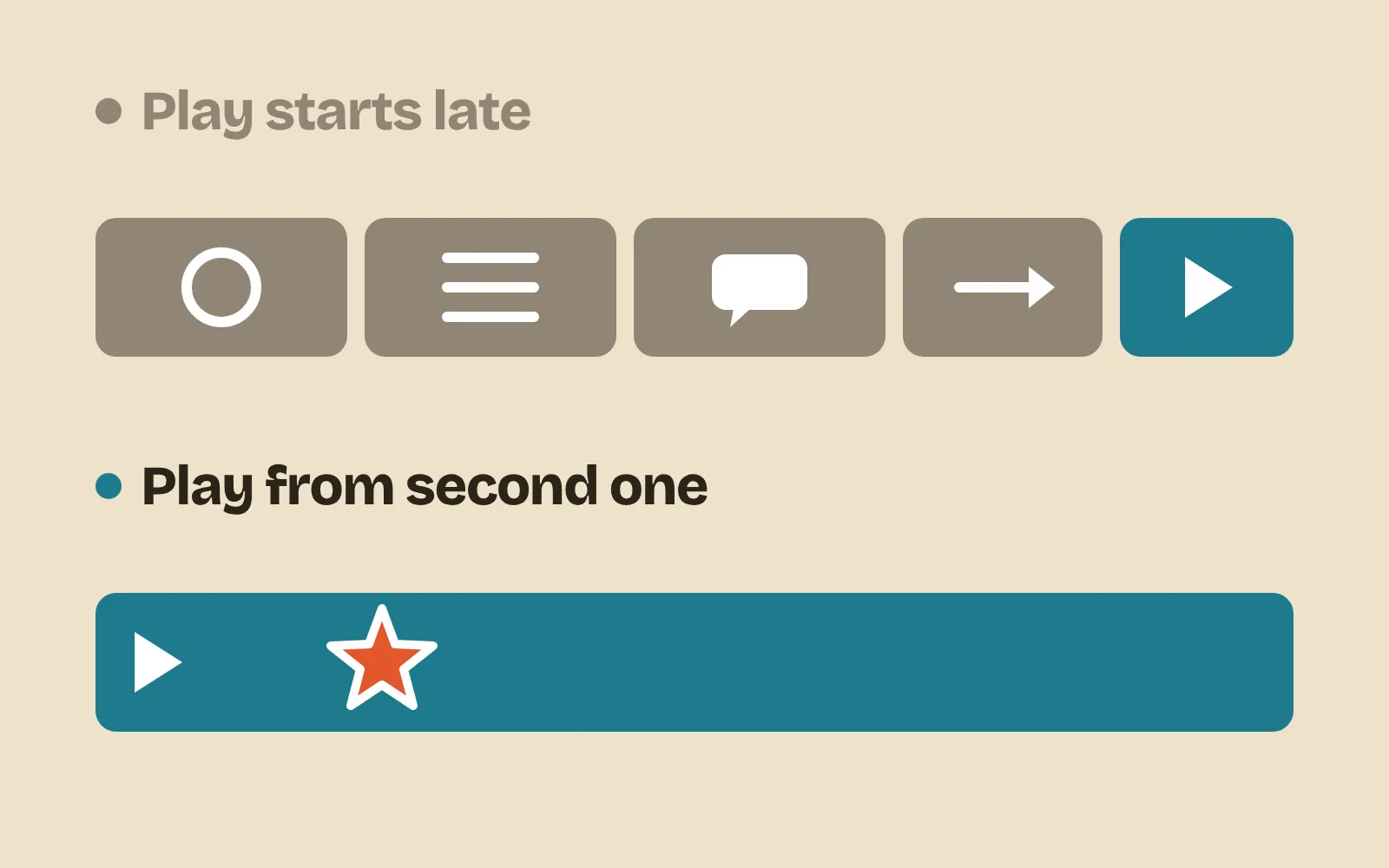
One press from launch to control. No unskippable logos, no chain of menus, no save-slot picker on a first run, and load the first level behind the title screen so there’s no loading bar after it. One Game Developer community blog puts it as players should be “pumped and ready to go in seconds” (Game Developer). The skill’s target: control within 10 seconds. On the left: 3 logos, a legal notice, Press Start, a main menu, a save slot, “Are you sure?” and loading, so play starts at 35.0 s in our demo. On the right: a title over the already-loaded level, one press, playing at 3.6 s.
2. Cold open
Start inside the core loop, in the middle of the action, not with a walk to where the action begins. Uncharted 2 opens with Drake wounded in a wrecked train hanging over a cliff; as Wikipedia puts it, “the story begins in medias res” (Wikipedia). The target is the first core action within 30 seconds. On the left, you have control at home but walk for 40 seconds past a tutorial sign before the first slime. On the right, you start mid-chase with a spike ball behind you, and stomp at 1.7 s.
3. First win
Give a clear win in the first minute, almost impossible to fail, with a sound and a small payoff. The same community blog advises rewarding players right after the tutorial, and warns that a weak opening can end in refunds (Game Developer). On the left, the first enemy is an armoured block that takes 3 hits while you have 1 heart: you die 3 times, and the win finally arrives silently at 41.8 s. On the right, the first slime is sleepy and can’t hurt you, and your jump is gently steered onto it: coins, a chime and “FIRST WIN!” at 2.7 s.
4. Story later
Your story matters, but not before the player knows why they should care. Put one or two short lines before play, and move the rest after the first win, in small pieces. Make every cutscene skippable, and say so on screen. In the Microsoft Research study, one player quit Blitz: The League over “too many unskippable cut-scenes”, though they could in fact be skipped; he just didn’t know (Microsoft Research). The left side copies that: six boxes, 87 words, and a skip that exists but nobody mentions (try Esc). The right side shows one 7-word line with “hold to skip” on screen, and plays at 5.4 s.
5. Defer setup
Don’t ask before play what you can default: name, difficulty, looks, brightness, options. A new player can’t make these choices well yet, because they don’t know what any of them changes. Pick sensible defaults and offer the choice once it means something. On the left: name entry, difficulty, a character creator, brightness and options, 13 presses and 23.5 s before play in our demo. On the right: no questions, playing at 2.6 s, and the settings are offered after the first stomp.
Fast, not empty
A fast start only helps if what comes next is worth staying for. A few rules the skill follows:
- Measure from launch. Seconds to control (under 10), to the first core action (under 30), to the first win (under 60), clicks before control (at most 2), words read before control (under 30).
- Keep the logos and the options, just move them. A studio logo after the first level, or a settings menu the player can find, costs nothing.
- Don’t let the first win teach the wrong thing. The easy first slime should still be stomped the same way as every slime after it.
What happens after the first minute is a pacing question: see pacing in video games. To teach the controls without text boxes, see tutorial design without text.
Add it to your game
- Copy the skill at the end of this page into your project.
- Ask your agent: “Get players into the fun within the first minute.”
- Play it, then tune in plain words: “The opening line is still too long, cut it to one sentence.”
Art in the demos: Pixel Platformer and Kenney Fonts by Kenney (CC0).
The skill that made it work
This is the whole skill we gave Claude Code. Copy it into your project and ask your agent to speed up your game's opening. Every trick sits behind its own switch, and the last step times the opening from launch to the first win.
- Time the opening from launch to the first time the player does the core action (jump, shoot, place, serve, match). List every logo, menu, cutscene, text box and choice before it.
- Put every trick behind one named switch in a single settings object, all on by default, so each can be tested on its own.
- instant-start. One press from launch to control. No unskippable logos, no menu chain or save-slot picker on a first run; load the first level behind the title screen. Target: control within 10 s of launch.
- cold-open. Start inside the core loop, mid-action, not with a walk to where it begins. Uncharted 2 opens in medias res, with Drake hurt in a train hanging off a cliff. First core action within 30 s.
- first-win. Give a clear win in the first minute: the first enemy down, first customer served, first line cleared, with a reward sound and a small payoff. Make it almost impossible to fail.
- story-later. At most one or two short lines before play; move the rest after the first win, in small pieces. Make every cutscene skippable and say so on screen. In a Microsoft Research study, a player quit Blitz: The League over cutscenes he didn't know he could skip.
- defer-setup. Don't ask before play what you can default: name, difficulty, looks, settings. Pick sensible defaults and offer the choice later, once the player knows what it changes.
- Measure it. With a script or a stopwatch from launch, record seconds to control, seconds to first core action, seconds to first win, screens and clicks before control, and words read before control. Targets: under 10 s, under 30 s, under 60 s, at most 2 clicks, under 30 words.
Save it as .claude/skills/first-minute/SKILL.md in your project. Or connect your agent and type /aigamedev: it loads this skill with its reference files and the results from this post.